
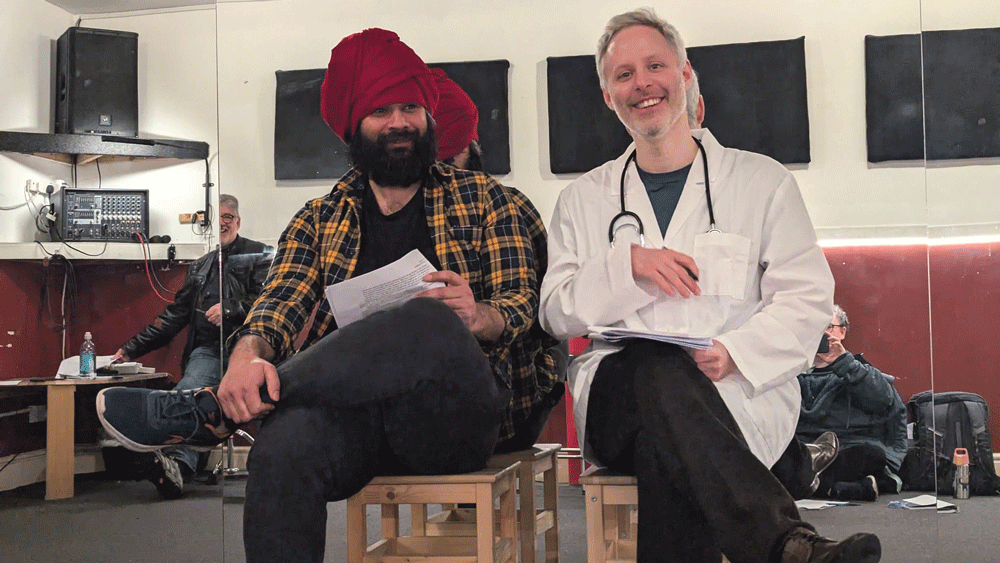
Actors and co-writers Ankit Raj Mathur and Darragh Scannell rehearsing for 'Lines of Exile'
‘Lines of Exile’ examines the two parallels of two partitioned nations
‘LINES of Exile’ is a new full-length play presented by Parallax Theatre Collective that examines the parallels of two partitioned nations.
Set in 1950 Lahore, Pakistan, it follows the story of Bishan Singh, a man with schizophrenia, who struggles to comprehend why he is being uprooted and sent to a new facility in Amritsar and why the country itself has been divided.
His psychiatrist, Dr Diarmaid Ó Flaithearta, tries to guide him through the confusion, even as he recognizes echoes of his own homeland’s partition.
Exploring mental health, displacement, and shared histories of colonial division, ‘Lines of Exile’ bridges the emotional landscapes of Ireland and India, offering a deeply human perspective on trauma, care, and belonging.
This week, The Echo sat down with director and co-writer Leah Flowers to discuss ‘Lines of Exile’; the show performs in the Civic Theatre on February 4 and 5.
There will be 3 performances across the 2 days, including 7pm performances for each night and a 1pm performance on the latter date.
Tickets are on sale now and can be purchased on the Civic website.
What can you tell us about the story of ‘Lines of Exile’ without giving too much away?
Lines of Exile is a new 70-minute drama, and its world premiere is at The Civic Theatre in Tallaght on February 4th, 2026.
Set in 1950 Lahore, Pakistan, during the final transfers of psychiatric patients following the Partition of India, the story follows a man with schizophrenia who struggles to comprehend why he is being uprooted and sent to a new facility in Amritsar—and why the country itself has been divided.
His psychiatrist, an Irish doctor, tries to guide him through the confusion, even as he recognizes echoes of his own homeland’s partition.
Lines of Exile uses the intimacy of small-scale performance to humanize history, creating space for dialogue about mental health and finding meaning and connection in the aftermath of division.
What inspired ‘Lines of Exile’?
Ankit Raj Mathur, an expat from India, brought this story to my attention after we had graduated from the UCD MA in Theatre Practice programme together.
He wanted to create a full-length play based on the short story “Toba Tek Singh” by Saadat Hasan Manto from 1955. Ankit recognised parallels between the partitions of Ireland and India and wanted to create a bespoke story for the people who live here: Irish, Indian, and Pakistani alike.

Director and co-writer Leah Flowers
What have been your favourite parts of producing this show so far, and why?
By far my favourite part of any production is the time spent in the rehearsal room because I really enjoy watching actors pour their passion, skill, and perspective into their roles.
This piece is a collaboration between myself (Leah Flowers, director and co-writer), Ankit Raj Mathur (actor and co-writer), and Darragh Scannell (actor and co-writer).
After we spent weeks researching, brainstorming, and workshopping foundational story elements, we had devising sessions in which I gave the actors free rein to improvise along set signposts within each scene.
They’re both skilled and intuitive, which helps a great deal, but they also have great scene-partner chemistry.
During the devising session for the turning point of the play, Ankit and Darragh were so in sync that it was electric.
I can’t wait to share that scene and this story with the Dublin community.
What have been some of the biggest challenges involved with producing this show, and how have you navigated them?
As a recent graduate of the UCD MA Theatre Practice programme and a US transplant, I didn’t know a lot of people fresh out of the scholastic environment.
The biggest challenge in the beginning had been finding a producer.
There aren’t a lot of them in Dublin, or at least I didn’t have any connections to any available producers when we started writing.
I invited Kevin Rahill, playwright and fellow UCD MA graduate, to see if he would produce.
He was uncertain at first, but I invited him to a rehearsal so that he could see the work firsthand, and before the session was up, he was excited to join the project.
I can tell you from this experience that having him on board has made a world of difference.
What messages are you hoping audiences will take from ‘Lines of Exile’?
The world is so divided right now. There is a lot of bigotry bubbling to the surface, here in Ireland, and worldwide.
Partition literally and figuratively divides people, and I’m not here to point to a particular ideology as the way forward, but I wanted to create a story that illustrates the humanity of two people caught in the middle of political strife.
I invite audiences to look closer at a person they might not think they identify with and see if they recognise something of themselves in another.
The reason I make theatre, which is such a hard thing to do, is because, at its best, theatre’s ability to bring people together is second to none.
What is next for Parallax Theatre Collective after this? Do you have any more projects or shows in the pipeline?
Parallax Theatre Collective has been selected to participate in the Scene + Heard Festival of New Work this February 19th with another original piece!
Ankit and I will continue our partnership with another piece conceived by him and written by both of us.
His master’s thesis was a play called The Ninefold Spiral based on his experience of the ancient and the modern and on East meeting West, and so he created a piece that blends the acting traditions of Stanislavski and the Rasa Theory of the Natyashastra.
Its first iteration was a one-person show in which he used voice recordings of real people from his life to tell a semi-autobiographical tale of a man choosing to follow his passion, even when faced with unsupportive loved ones and a difficult industry.
Each scene is based on a rasa, or core emotion.
We have developed an expanded version that includes dance interludes between each scene that embody the rasas through a fusion of Bharatanatyam, Bhangra, and hiphop.
Who would you like to thank for helping to make this play possible?
I’d like to thank Ankit Raj Mathur and Darragh Scannell for their hard work over these few months and Kevin Rahill for being an amazing producer.
Thank you to Donal Shiels for saying yes to our project, and a big thanks to my husband, Michael Flowers, who encourages my creative work and is my number one supporter!

