
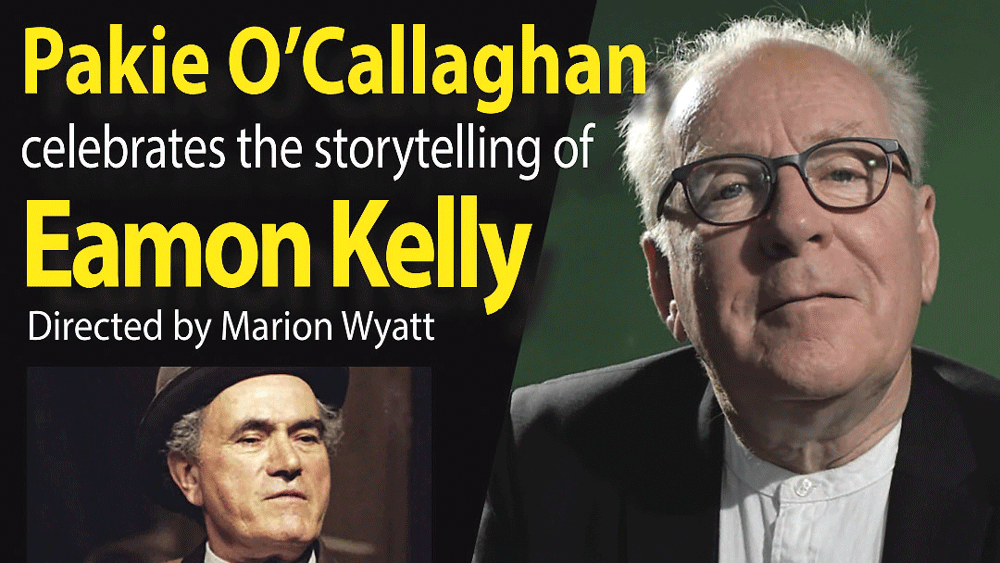
A Celebration of The Stories of Eamon Kelly comes to The Civic
PAKIE O’Callaghan’s ‘A Celebration of The Stories of Eamon Kelly’ aims to honor the work of arguably Ireland’s greatest storyteller.
O’Callaghan takes Kelly’s best-known stories, including ‘The mirror,’ ‘The looking glass,’ and ‘The woman who married the blacksmith,’ and intersperses them with the music of Sliabh Luachra, played by Aileen Collins and Catherine Frost, to create an evening of “spellbinding” theatre.
The stories capture the life, times, and happenings of rural Ireland in more innocent times and will evoke memories of a world that moved at its own pace dictated only by the weather and the seasons.
O’Callaghan has been described by the Sunday Times as “peerless at what he does.”
This week, The Echo sat down with Pakie to discuss ‘A Celebration of the Stories of Eamon Kelly,’ which will be performed in the Civic Theatre from January 28 to 30.
There is a 7:30pm performance on each of the three days, accompanied by a 1pm performance on January 29; tickets are on sale now.
What inspired you to present a celebration of Eamon Kelly’s storytelling? Did you know of him and his work before this production?
I was performing on Liveline’s Funny Friday for almost 20 years until Joe Duffy’s recent retirement, mostly mimicking politicians from the Healy-Raes to Donald Trump and everyone in between.
Liveline devoted a program to celebrate storytelling in Ireland in late 2024, and I was asked to tell a couple of stories.
The only stories I knew were ones by one of my theatrical heroes, Eamon Kelly.
After the program I was approached to do a show based on his work, and after getting the blessing of Eamon’s family, I set about doing just that, and so ‘A Celebration of the Stories of Eamon Kelly’ was born.
To me Eamon Kelly is up there with the greats of Irish theatre, and while he hasn’t been forgotten, I think it’s fair to say he’s been neglected in recent times, and I hope that this show goes a small way towards redressing that.
As part of my research for this show, I’ve spent a lot of time in the National Library going through the very extensive archive of Eamon Kelly’s work, which was kindly donated by the Kelly family.
It’s hard not to be impressed by the extraordinary output that Eamon Kelly produced during his extremely busy and productive life.
What has been your favorite part of working on the show, and why?
Most actors will be very surprised to hear me say that my favorite part of working on the show has been learning the lines.
Every time I read one of Eamon’s stories, I find another little nugget, a nuance I hadn’t spotted before.
The stories describe life in rural Ireland at a time when the only form of entertainment was the Rambling House, where people gathered in the evening to discuss the happenings of the day; those who’d been to a fair or a market would be expected to bring home the bacon but even more importantly the “news”; those who’d been to a funeral or a wake would be expected to describe the goings-on there, who attended, and even more importantly, who didn’t, etc.
For people who lived through the pre-TV period in Ireland, this will be a trip down memory lane, and for younger people, this will be a social history lesson because, apart from being an extraordinary storyteller, Eamon Kelly was an immensely important social historian.
What have been some of the biggest challenges involved in the production, and how have you navigated them?
I’m primarily a mimic.
Many years ago I had great fun taking off Charlie McCreevy, Des O’Malley, Roy Keane, and many others on the TV program ‘Bull Island,’ and more recently I was doing something similar on Joe Duffy’s ‘Funny Friday.’
I was determined that this show would not mimic Eamon Kelly, that this would be my interpretation of these wonderful stories, and my director Marion Wyatt ensured that I didn’t stray into Eamon Kelly’s voice or mannerisms.
I have to confess that it did present a challenge early in rehearsals, but I think that I eventually found my own voice, and I also made a point of not watching any clips of the great man performing.
Have you performed at the Civic before?
Over the years in Dublin I have performed at Vicar Street, The Olympia, and The National Concert Hall, but it’s my first time at the Civic, and I’m really looking forward to it.
They have a great team there and have been very warm and helpful.
How do you prepare for each performance? Are there any specific processes you have to go through?
I’m accompanied on stage by two highly talented musicians who play the music of Eamon Kelly’s home place on the Cork-Kerry border throughout the show, but in a sense I’m on my own if anything goes wrong, so I try to prepare really well in terms of having the lines off and remembering the moves.
I can never eat for a few hours before the show, and I always pray for fine weather, as my pre-show ritual is to go for a 30-minute head-clearing walk.
What is next for you after this?
For eight years I collaborated with Frank Twomey on the ‘Santa Ponsa’ stage shows, which toured to every corner of the country.
Frank was loved by a generation of children for his performance as Frank on ‘Bosco,’ that iconic RTE children’s program that ran for almost twenty years.
Sadly, Frank died two years ago.
I have an unfinished script we were working on and am determined to finish it as a remembrance of Frank.
TAGS Life

