
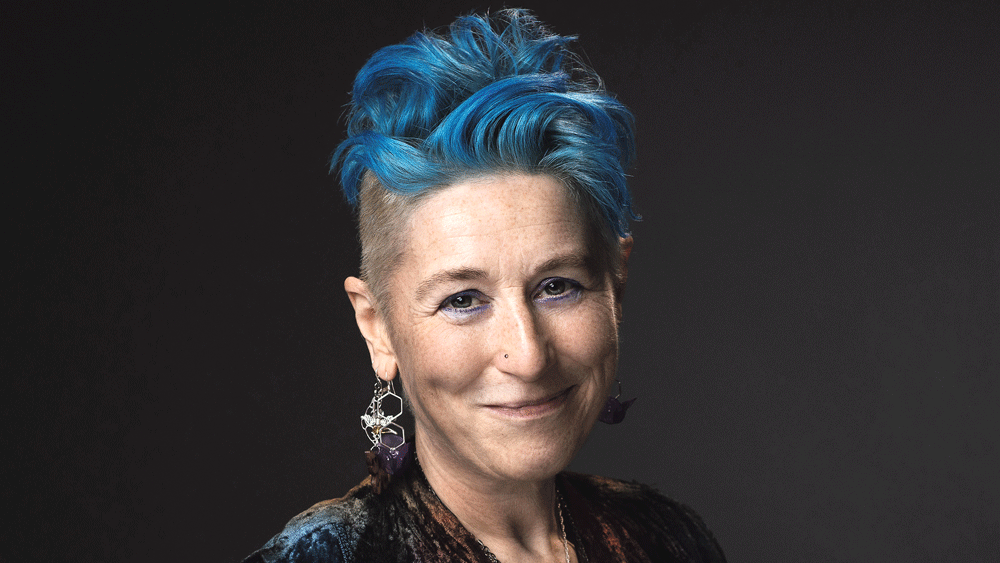
Tallaght author Nicola Pierce
Nicola thrilled to win History Book of the Year prize
BESTSELLING Tallaght author and former ghostwriter Nicola Pierce was thrilled to take home the Hodges Figgis History Book of the Year from the 2025 An Post Irish Book Awards.
With a focus on history and historical fiction for children, her latest work is ‘Great Irish Wives’, which serves as an overview of some of the most iconic women in Irish history.
Her first novel, ‘Spirit of the Titanic’, was reprinted five times within its first twelve months after The O’Brien Press published it in 2011.
Her second novel, ‘City of Fate’, about World War II’s Battle of Stalingrad, was shortlisted for the Warwickshire Year Nine Book Award 2014.
In 2015, The O’Brien Press published ‘Behind the Walls’, about the 1688-9 Siege of Derry. ‘Kings of the Boyne’, released in 2016, was shortlisted for the 2017 LAI Children’s Book Award.
April 2018 saw the publication of her history book for adults, ‘Titanic: True Stories of Her Passengers, Crew and Legacy’.
‘Chasing Ghosts: An Arctic Adventure’, about the lost John Franklin expedition, was published in March 2020.
‘In Between Worlds: The Journey of the Famine Girls’, inspired by young Irish women sent to Australia during the famine, was published in September 2023.
This past December, we sat down with Nicola to discuss her ‘Great Irish Wives’, as well as her win.
What can you tell us about the synopsis of ‘Great Irish Wives’?
My book tells the stories behind the ten women who married Ireland’s most famous men from history, starting with Matilda (Wolfe) Tone, Mary (Daniel) O’Connell, Constance (Oscar) Wilde, Emily (Ernest) Shackleton, Annette (Lord Edward) Carson, Charlotte (George Bernard) Shaw, George (William Butler) Yeats, and Sinéad (Éamon) de Valera.
The list also includes Margaret (Harry) Clarke and Beatrice (Brendan) Behan.
I wanted to show how important they were to their husbands’ achievement.
These men were free to marry, become fathers (excepting GB Shaw), and then spend any amount of time and energy on chasing their dreams thanks to the emotional and mental support they received from their wives.
This is what unites them; they married very well.
What inspired you to write this book? How did your ideas for it come to fruition?
It was a middle-of-the-night idea, thanks to my book about Dublin’s O’Connell Street.
On receiving a couple of letters from readers asking me to do a history of Grafton Street, I put together a proposal for my publisher which was sadly rejected.
However, one fact that I discovered was that Wolfe Tone and his wife, Matilda, fell in love on Grafton Street.
I had not known he was married. I began to think about that and then wondered if the likes of Daniel O’Connell were married, and from there, the idea exploded into what became the book today.
What was your favourite part of working on this book, and why?
Reading is just about my most favourite thing, and this is what was required as I was dealing with ten women I knew little or nothing about. I searched for old books, acquiring quite a library, to write this one book, but it was worth every penny.
My priority was memoirs, diaries or letters. For instance, there did not seem to be much information available about Sinéad de Valera, but then I discovered that she contributed a chapter about herself in her son Terry’s memoir.
When in Dublin, I’d visit the second-hand section in ‘Chapters’ on Parnell Street.
‘Books Upstairs’ in D’Olier Street, and not forgetting ‘The Secret Bookstore’ on Wicklow Street.
What were some of the biggest challenges you encountered while working on this book, and how did you navigate them?
Well, the biggest challenge of all was the devastating news last November (2024) of my husband Niall’s terminal cancer diagnosis. He was given five months but only made it to seven weeks, dying on January 3 2025.
The book is dedicated to him.
I started out writing this book as a wife. Five of the women were widowed – Matilda Tone, George Yeats, Emily Shackleton, Margaret Clarke and Beatrice Behan – and I wrote their stories without any idea that by the time I finished the book I would be a widow too.
I had just started upon my last wife, Annette Carson, when Niall died.
After the funeral, it took an enormous amount of effort to return to the manuscript, and I relied on my friend, biographer Eleanor Fitzsimons, to help with Annette’s research.
I could have told my publishers that I was out of action until 2026, but I knew that I needed something to look forward to in 2025.
I have gotten through a lot of firsts by now – his birthday, my birthday and our wedding anniversary – but, of course, Christmas is going to be the big one, and then there is New Year’s Eve, followed swiftly by his first-year anniversary.
Meanwhile, the book has rewarded me with some incredible experiences, including my first award in a fourteen-year career, winning the An Post History Book of the Year.
Also, it was launched in Waterstones, Drogheda, by Blanaid Behan, daughter of Beatrice and Brendan, which was very special.
It has been two years since we last spoke; what have been some of the biggest events or projects that you have been involved in during that time?
I have been suffering from writer’s block since finishing Great Irish Wives.
The ideas are coming, but I am struggling to settle down.
As a new widow, I developed a habit of keeping busy socially, which really helped me, but I know the time has come to relearn how to establish a work routine and get used to spending days alone again in my writing cabin.
TAGS Life

