
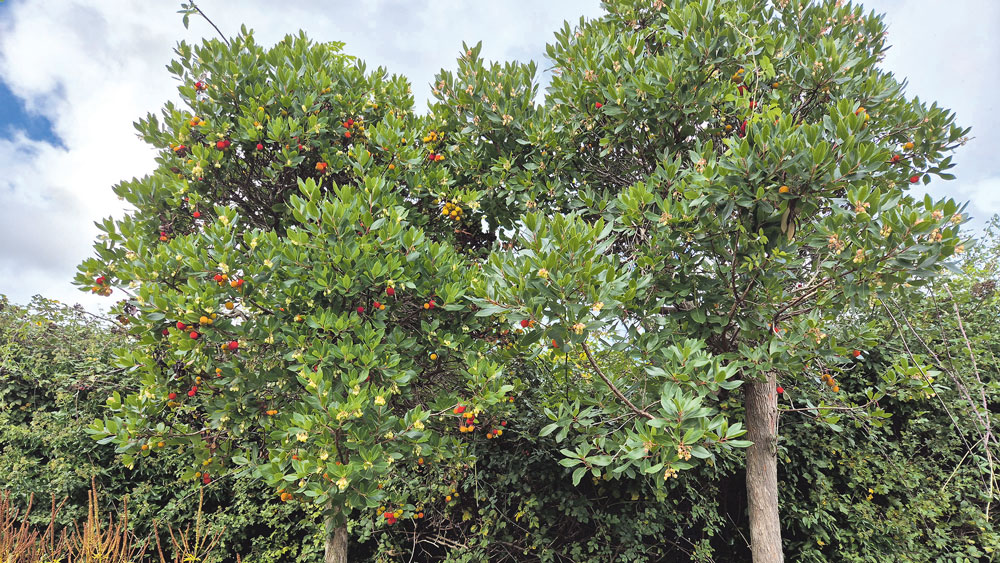
A line of lovely Arbutus grows in Tymon Park at Wellington Lane
Nature on our doorsteps: Arbutus, the Strawberry Tree
Rosaleen Dwyer is the County Heritage Officer at South Dublin County Council – every week she gives us an insight into the natural heritage around us and the beautiful biodiversity of the plants and creatures.
THE Arbutus tree’s lovely creamy white bell-shaped flowers emerge in October and November.
Interestingly, at the same time, last year’s immature fruit begin to ripen, progressing through bright yellow and orange colours before maturing into soft, red, ball-like berries.
This final red stage gives the plant its common name of Strawberry Tree.
While Arbutus has long been considered a native tree, recent research suggests a different, fascinating, origin for this plant.
Arbutus is one of a small group of Irish species that are referred to as the Lusitanian Flora.
These species occur naturally mostly only along the coasts of Spain and Portugal, but not in Britain nor inland on the European continent.
It had been suggested that, before the last Ice Age, Arbutus also once occurred naturally in Ireland. It was thought that it somehow managed to survive in the milder areas of south Kerry.
Recent research suggests, however, that Arbutus was probably introduced into Ireland around 4,000 years ago.
At that time, large copper mines were first detected on the shores of the Lakes of Killarney, attracting Bronze Age miners from western Portugal and Spain where mines already occurred.
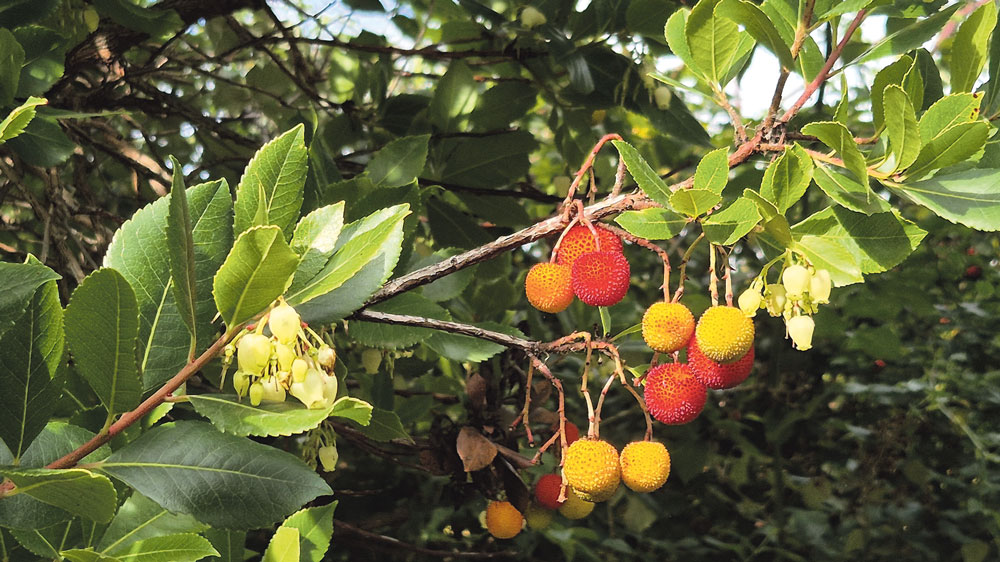
This year’s white flowers and last year’s colourful ripening fruit occur together on the Arbutus tree
These mining communities would have travelled with supplies of their own local species as food, and perhaps as working materials.
While Arbutus berries are said to be edible, they are not very palatable.
The Latin name for the plant is Arbutus unedo, where ‘unedo’ indicates ‘I eat once only’.
However, it is known that very ripe Arbutus berries produce alcohol naturally, and that today it is used in the Mediterranean region to produce brandy.
It is very likely therefore that the Bronze Age miners that travelled to Killarney to mine for Irish copper could indeed have brought Arbutus berries with them, and that some of these berries were the origin of the Arbutus trees now growing in Ireland.
DNA studies appear to support this origin theory, as the Irish trees are genetically identical to the Arbutus trees growing today in Spain.

