
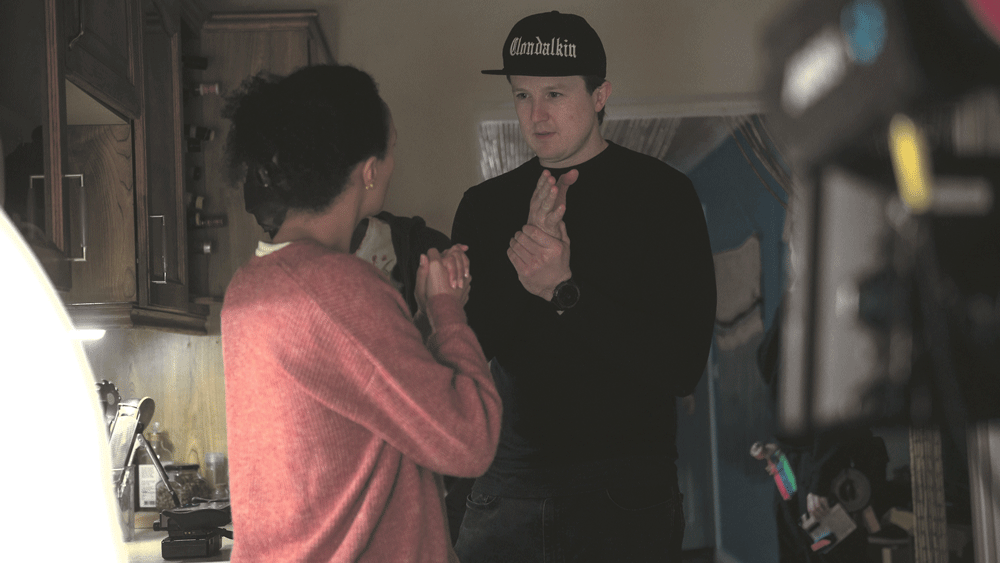
Clondalkin-based director Alan Hopkins on the set of 'A Knock at Your Door'
Photo by Owen Behan
‘A Knock at Your Door’ gets ready for international festival
HAL Pictures Ltd., founded by Clondalkin-based writer/director Alan Hopkins and producer Husni Hafid, has completed principal photography on their Screen Ireland-supported film ‘A Knock at Your Door’.
This is described as a “timely and visceral” short film which confronts the “explosive” rise of far-right mobilisation, disinformation and anti-migrant violence in post-Dublin Riots modern Ireland.
The film follows a young couple who choose to shelter an injured teen, but must face their own prejudices and hard truths and relationship values, as fear and a violent mob close in.
The film stars the 2026 IFTA-nominated Diarmuid Noyes (‘Christy’) and Yemisi Oyinloye (‘Cold Feet’), with Jonathan Heed (‘Bow Street’) and Michael Mullen (‘The Problem With People’) rounding out the exciting young cast.
Shot on location in Dublin in early 2026, the film is positioned to resonate with wide audiences as an urgent cinematic response to the nation’s recent social upheavals.
‘A Knock at Your Door’ marks Hopkins’ sophomore collaboration with Screen Ireland after the award-winning lush period drama ‘Ogham’ (2024), which had sold-out premieres at the Galway Film Fleadh and Dublin International Film Festival.
This project also reunites Hopkins with Hafid, with whom he previously collaborated on ‘Ogham’ and the critically acclaimed ‘Jungle’ (now available on the RTÉ Player), continuing a creative partnership rooted in socially relevant cinema.
This week, The Echo sat down with Alan to discuss ‘A Knock at Your Door’, currently in post-production and being prepared for an international festival launch this summer.
What can you tell us about ‘A Knock at Your Door’ without giving too much away?
A young Dublin couple’s quiet evening in front of the TV comes to an abrupt halt with banging on their front door.
James and Florence open it to find Alex, a young teenager, badly beaten and looking for help.
Florence, a nurse, takes him inside, but James is immediately wary of the situation.
Alex is soon pursued to the house by an angry mob. James and Florence must decide where their moral compass lies, and if an internet accusation is enough to condemn a person to mob justice.
What was it that inspired you to make this film?
The film came from a place of exasperation with the current state of our political climate.
I think there will not be a person who reads this article that hasn’t had a friend or loved one whom they can feel they are losing, slipping away, tumbling down internet-fuelled rabbit holes, and becoming a spreading vector of racism, hatred and misinformation.
I think at the sharp end, we have the ugly scenes that we saw outside Citywest earlier this year, but also, on a smaller scale, it is the media people are consuming on their phones in the safety of their own homes, leading them in some cases into violent echo chambers and isolating them from their own families, friends, and communities.
‘A Knock at your Door’ is my attempt to distil a lot of these disparate issues into a single contained narrative that highlights the dangers of internet misinformation.
I understand this is quite a large-scale production; at one point, you used 100 extras for crowd/riot scenes; how did you organise this? I can’t imagine it was easy!
Well, I’ll be honest, getting one hundred people to show up to anything other than a funeral is a tough ask these days, when people have such busy schedules.
I think where we were lucky was that we had such a level of support for the film’s subject matter from our community and wider networks.
I had friends, neighbours, work colleagues and even pets come down on what
It was a very cold evening. So I will be forever indebted to them for giving their time and patience with the always slower than people realise, filmmaking process.
Production on the film recently wrapped; if you had to pick a favourite part or highlight of the process, what would it be and why?
I would have to just follow on from the previous question.
I love to work with actors, and getting to work with this amazing cast was a joy.
But I have to say the highlight for me was having so many friends and family join us for the crowd day and being able to show them a glimpse of what it is that I do for a living.
It added such a great community feel to the project and really held up a positive mirror to the negative anti-community activities we were portraying in the film.
Aside from the earlier point about extras, what other challenges did you encounter during this production, and how did you navigate them? Would you say it was daunting working on a larger-scale production than past projects like ‘Ogham’ or ‘Jungle’?
To be honest, every film presents its own unique challenges.
We thought having a familiar domestic location for this story meant we were making things easier.
But there will always be new or unforeseen challenges.
With this story, we understood the sensitivities of the topic, and I think the biggest challenge is making sure that we are being honest in our approach to the storytelling.
We would like to think we are getting used to the increasing scale of each production and just hope we can continue to deliver stories that engage audiences and spark conversation.
The film is currently in post-production and being planned for an international festival launch this summer; do you have any teasers for that? Do you expect the film will be available to view in other formats (streaming, television, cinema, etc.)?
We will release a trailer through our website, in May, with the film scheduled to premiere at the Galway film Fleadh in July.
Once the film has had its festival run, we hope to find a home online for the film, somewhere like the RTE player, where our previous film ‘Jungle’ can be found currently.
Who would you like to thank for helping you to make this production and this film possible?
We firstly would like to thank our amazing crew; without them, we wouldn’t have a film.
Secondly, our wonderful cast: Jonathan Heed and Micheal Mullen.
Yemisi Olinloye and Diarmuid Noyes for bringing the characters to life with such sensitivity and commitment.
We have to thank Screen Ireland, which has been so supportive of us and backing this project.
The whole Team there particularly Jennifer Smyth and Emma Scott, who have been with us throughout. Finally
everyone who helped us along the way, in particular my family, we owe so many people a pint and a hug for getting us over the line.
Lastly, we must mention Sean Bassett, and only he will know why, but we are grateful nonetheless.
TAGS Life

