
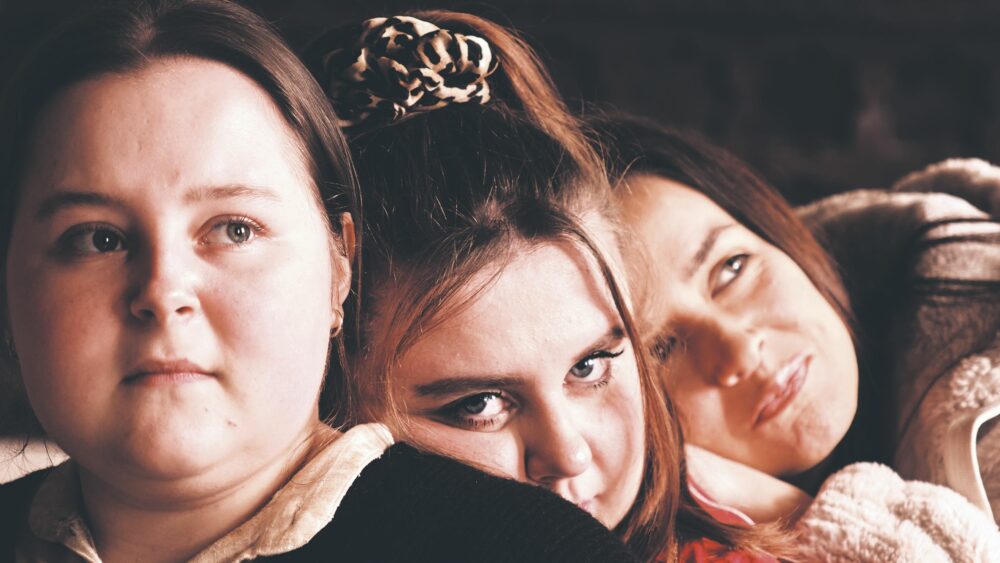
Erin Murray Boyne, Sophie O'Toole, Ciara Byrne starring in 'A Recurrence'. Photo by Vlad Gurdis
‘A Recurrence’ explores lives of three working class women across 3 generations
‘A RECURRENCE’ is a raw, urgent new play exploring pregnancy, poverty, and bodily autonomy through the lives of three working-class Dublin women across three generations.
Set inside a 1930s tenement, a 1990s flat, and a present-day council house, it asks a simple but urgent question: how much has really changed for working-class women in Ireland?
‘A Recurrence’ follows Minnie, Jasmine, and Grace as they each navigate an unplanned pregnancy under vastly different circumstances.
As their stories unfold in parallel, movement, gesture, and sound weave the decades together, revealing how history repeats itself in the lives of women whose choices are shaped by poverty.
The tenement, the flat, and the council house are more than settings— they are systems. Different buildings, built to contain the same struggle, exposing how poverty is never erased, only rebuilt.
Following their award-winning, sold-out Dublin Fringe debut, ‘That’s Sooo Povo’, D’Girlos Theatre Company return with a powerful new work that shifts their focus from class in the arts to the intimate realities of home, survival, and reproductive autonomy.
Unflinching and deeply human, ‘A Recurrence’ asks what it takes to break cycles that have endured for generations.
This week, The Echo sat down with Sophie O’Toole and Trudy Nolan to discuss ‘A Recurrence’, which performs in the Civic Theatre from September 2 to 13; for more details, check the Civic’s website.
The company made its explosive debut at last year’s Dublin Fringe Festival with ‘That’s Sooo Povo’; would you say the feedback and experiences of that first show have influenced your production of ‘A Recurrence’?
Last year’s festival was a bit of a whirlwind, and everything for the company ever since has felt the same way. In terms of style, this piece differs greatly from the last, although we are still heavily influenced by our own communities’ and families’ histories, and we are still moving through our work using the same tools, like sound, movement and spoken word.
We definitely feel more prepared for the festival this year with a better understanding of what needs to be done and how to get the most out of a piece.
Most of the feedback last year was incredibly positive, and so we are just aiming to have the same reception again this year and continue to grow as a company and as theatremakers.
What would you say was your inspiration for ‘A Recurrence’? Did you already have the idea for the story before ‘That’s Sooo Povo’? ‘A Recurrence’ actually came long before ‘That’s Sooo Povo’.
The idea began while Sophie was on her residency with Axis Ballymun. During that time, she became deeply influenced by the stories her family shared about their history, moving from the tenements to Fatima Mansions and then into council housing in Crumlin.
What struck her was how each move was framed as an improvement, yet many of the same struggles remained. The housing changed, but the underlying issues didn’t.
That led Sophie to start researching Dublin’s tenements, taking historical tours, and continuing conversations with her family.
She became fascinated by the idea that history doesn’t necessarily repeat itself exactly; it recurs, changing shape while the same patterns persist. Although ‘A Recurrence’ was developed first, Sophie put it on the shelf for a while.
In many ways, the themes that eventually emerged in ‘That’s Sooo Povo’ were already present in this earlier work. It wasn’t until Trudy heard Sophie read a monologue from ‘A Recurrence’ that she immediately asked, “Why aren’t we making this?”
That conversation was the catalyst for finally bringing the piece to life.
What has been the biggest highlight of working on ‘Recurrence’ so far and why?
This play feels a lot more intimate and personal and less spectacular than our last production which is really special and nice for us to explore together.
We’ve always said we consider ourselves sisters, but through the writing process of this show we’ve brought ourselves even closer together and strengthened our bond.
We know that we can write comedy and combine it with glitz and glam to create a spectacle with a message, but it’s nice for us to slow things down and explore the deep roots in our history and how generational trauma affects young working-class women.
The characters we write are always loosely based on people we know, our own friends and family, and it’s a huge highlight to share that experience or exploration and process with each other.
We are also really enjoying working with our beautiful actors Erin Murray Boyne and Ciara Byrne. They’re both extremely talented and bring so much care to the characters they’re playing, which is really exciting to watch.
And also to mention that this production will be Trudy’s directorial debut! Which is also really exciting for the company.
It’s also such a highlight to bring this play with the Dublin Fringe Festival to our local community of Tallaght. Trudy is Tallaght-born and bred, and Sophie has a lot of connections in the community and in the arts ecosystem here.
It’s really important to both of us to bring our work to the communities that inspire the work and to bring the Fringe community out to our ends as well.
We absolutely love working with the Civic, and we’re just honoured that they’ve been so supportive and eager to host and support us.
Would you say there are different challenges to this show’s production compared to your previous work? If so, why, and how have you navigated them?
I wouldn’t necessarily call them challenges; it’s more that this production has pushed us in different ways.
‘A Recurrence’ has a longer run than our previous work, which means we’ve had to think much more strategically about marketing and reaching new audiences over a sustained period. We’ve also been more ambitious creatively.
From the set design to the costume design, we’ve allowed ourselves to dream a little bigger and invest more into building the world of the piece.
It’s been exciting to expand our vision and collaborate with more artists to bring it to life. Rather than navigating obstacles, it’s really been about embracing the opportunity to grow as a company and challenge ourselves to make work on a larger scale while staying true to the heart of the story.
What are you hoping will be audiences’ biggest takeaway from ‘Recurrence’? What is the central message you would like to convey?
We hope audiences leave with a little more compassion and curiosity about the stories we inherit and the stories we tell about one another. ‘A Recurrence’ is about recognising that history doesn’t simply repeat itself; it recurs.
The circumstances change, but the systems, expectations, and judgements placed on women often remain the same. At its heart, the play asks audiences to question the stories that become accepted as truth.
How many women have been remembered only for the worst day of their lives? How many have been reduced to a warning instead of being understood as full, complicated human beings? While the play explores difficult themes, it’s ultimately about hope.
Grace’s story, one of our characters played by Ciara Byrne, asks whether a cycle can finally be broken, not by forgetting the women who came before her, but by carrying their stories with honesty instead of shame.
We want audiences to leave believing that the past doesn’t have to determine the future and that empathy has the power to change the stories we pass on.
Who would you like to thank for helping to make this show possible?
There are so many people and organisations who have supported ‘A Recurrence’, and we’re incredibly grateful to all of them. We’d like to thank The Civic, Dublin Fringe Festival, Tallaght Community Arts, Axis Ballymun, Field: Arts, and Gorilla Design for believing in the work and helping us bring it to life.
We’re also endlessly thankful to our friends, families, and the communities that have supported us throughout this journey. Their encouragement, honesty, and generosity have shaped this piece in countless ways.
And finally, to all our girlos and everyone who comes to see our work, thank you.
Your support allows us to keep telling stories that matter, and we wouldn’t be here without you.
TAGS Life

