
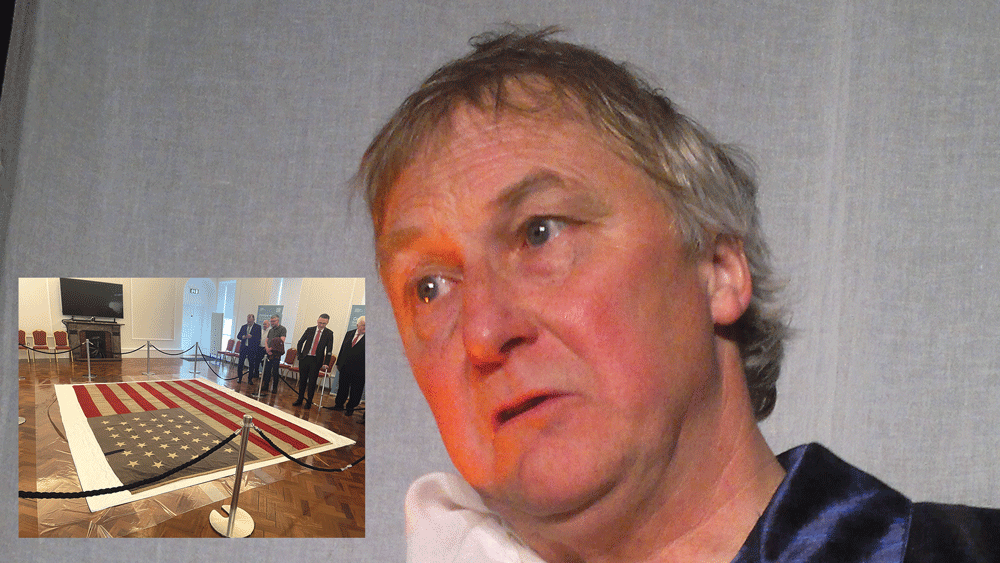
Donal O'Kelly performing in the show as the "Fenian jailbreaker supreme" John Breslin reads a letter from his French lover Marie Tondut and (inset):The Catalpa flag on display in the National Museum at Collins Barracks at Easter
‘Catalpa’ is a masterclass in solo performance
A CLASSIC of modern Irish theatre, Donal O’Kelly’s ‘Catalpa’, with live music by Trevor Knight, is the story of the daring 1876 whaleship rescue of six Irish prisoners from the British Fremantle penal colony in Australia.
This is all portrayed through the imagination of a rejected screenwriter, presented in the Civic on the exact 150th anniversary of the historic escapade.
Described as ‘Moby Dick’ meets ‘Gone With The Wind’ with a passing glance at ‘The Great Escape’, ‘Catalpa’ is a subversive epic that challenges the handed-down concept of heroism.
Presented in the Civic on the exact 150th anniversary of the historic escapade,’Catalpa’ is an internationally acclaimed, award-winning one-man play written and performed by Irish playwright and actor Donal O’Kelly.
It has won the Fringe First Award in Edinburgh and the Best Event Award at the Melbourne International Festival.
Premiering in 1996, the play is a masterclass in solo performance, using minimal props to tell an epic adventure story.
This week, The Echo sat down with Donal to discuss ‘Catalpa’, which performs in the Civic for one night only on August 19 at 8pm; booking details are available on the Civic website.
How did you first come to know of the story of the Catalpa?
In 1992 I was in the Perth Festival with another solo show and heard about the Catalpa rescue of six Fenian lifers from the nearby Fremantle penal establishment.
Back in Dublin, in the Winding Stair, I came across Seán Ó Lúing’s excellent 1960 book, Fremantle Mission.
I hit on the idea of a writer acting out the whole epic in his head – the greatest film never made.
What inspired you to tell this story?
There’s some interest now in the Catalpa expedition; the National Museum displayed the flag, and the National Library has an exhibition running, but 30 years ago not many people knew about it.
I wanted to make people aware of this amazing collective event in Irish history involving so many people working selflessly for a common purpose.
I also saw it as a display of live theatre’s ability to build a participatory, imaginative bond with the audience so the actor and audience go on a journey together.
I still believe in that as much as ever – the power of live theatre.
What has been your favourite part of working on this production so far and why?
I saw the world-touring Catalpa – New York, Chicago, Boston, Melbourne, London, Paris, Minneapolis, Helsinki, Lusaka, Harare, Inis Bofin, Tory Island … so many memories of so many places!
Performing with Trevor Knight playing live is also a very enjoyable experience, and I’m really glad we’re doing it this one last time in the Civic, where Catalpa always drew fantastic audiences.
What have been some of the biggest challenges involved in working on this production so far, and how have you navigated them?
In a solo show, learning the lines is a fairly major factor, but you don’t get the chance to look over them while some other scene is rehearsing, as in most plays.
That was a challenge first time around.
Also, I was very lucky to have former sailor Tich Meagher in the room as stage manager, as he taught me the layout of a sailing ship and made sure I was making sense.
What are you hoping will be the audience’s biggest takeaway from this performance?
The Catalpa success was a sensation in international media of its time.
There was an enormous torchlit celebration in Dublin that ended up burning a giant effigy of British PM Disraeli, who had rejected a plea by 138 MPs to grant humanitarian release to the Fenian prisoners under life sentences.
He didn’t know they’d already been freed because the undersea telegraph cable in the Timor Sea had been severed so the Royal Navy couldn’t be alerted.
This was a colossal international event of resistance.
When Catalpa arrived in New York, it is said, was the cause of the first-ever ticker tape parade through The Bowery.
It was a turning point in Irish history that culminated in the 1916 Easter Rising forty years later.
What message are you hoping they take from it?
I hope it inspires people to engage in humanitarian efforts no matter how futile they might appear, such as we saw last month from the Gaza Sumud flotilla volunteers, including fifteen Irish people.
I wrote Catalpa in the format of the ancient Greek hero’s journey but intended it as a subversion of its patriarchal tradition, and I hope that still comes across as much as ever.
What is next for you? Do you have any other projects planned for the rest of 2026?
The week following ‘Catalpa’ in the Civic Theatre on Wednesday, August 19, and in Dublin Municipal Theatre Smock Alley from Tuesday, August 25 to Saturday, August 29
I’ll be presenting ‘The Catalpalyst’, an analysis of the Catalpa rescue according to my thoughts thirty years later.
I’m enjoying looking at Catalpa through that lens as well. Catalpa took place in 1875-76 a decade after the abolition of the enslavement of three million African-Americans in the US, when genocidal warfare was being waged against the prairie Native American tribes such as the Lakota and in Australia against the Aboriginal people, the last surviving indigenous Tasmanian, Truganina, dying in 1876.
I think historical context is important for guiding us into a knowledgeable, sustainable future.
Who would you like to thank for helping to make this production possible?
I’d like to extend sincere thanks to my long-time musical companion on many Catalpa travels Trevor Knight and original director Bairbre Ní Chaoimh, and I’d have to mention the late, fabulous Tich Meagher, who’d sailed on Asgard II and knew all about sailing ships.
For this 150th anniversary presentation, I’d like to deeply thank everyone at the Civic, which has always been one of my favourite theatres.
One last time! Stow the anchor chains!
TAGS Life

