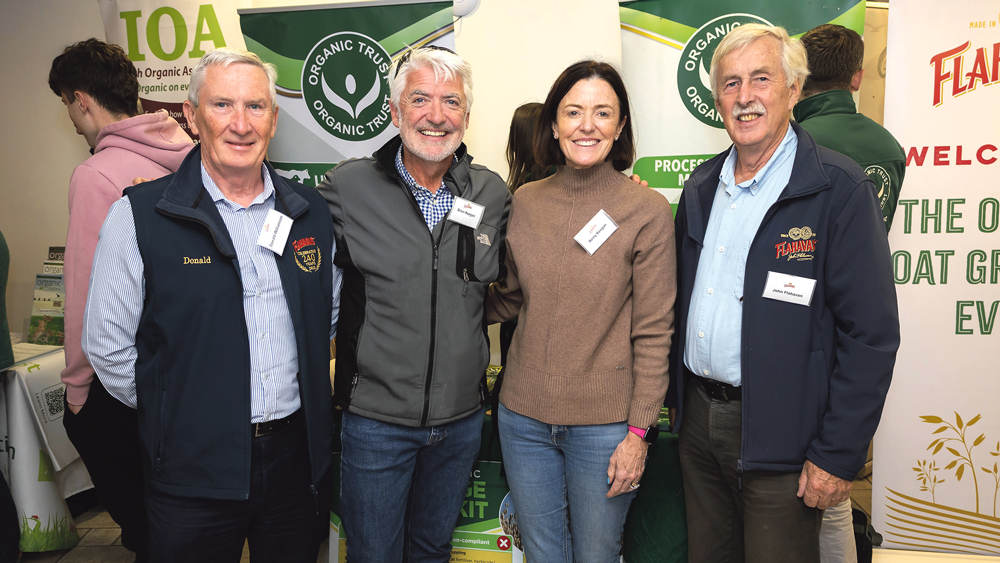
Donald Williamson, Chairman Flahavan's, Brian Keegan, Kerry Keegan and John Flahavan at the Flahavan’s Organic Oat Growers Conference
Future looks oat-standing
LUCAN farmers were in attendance at at Flahavan’s annual Organic Oat Growers Conference, where new research into oat varieties and advances in crop management were discussed.
Lucan-based Brian and Kerry Keegan attended the conference that brought together organic oat growers, farmers considering conversion, researchers, agricultural advisers, government representatives and industry stakeholders to explore how innovation, investment and cooperation can support a more commercially resilient Irish tillage sector.
Wateford oatmakers Flahavan’s has experienced a five-fold increase in demand for its organic oats since 2010, including export growth, and used the occasion to encourage discussion on opportunities extending beyond organic oats to the wider tillage and agricultural sectors.
Flahavan’s Head of Operations Johnny Flahavan said: “Our growers are central to the success of our organic oat business, but many of the challenges and opportunities we face are shared right across Irish tillage and agriculture.
“We see real value in bringing farmers, researchers, advisers and industry together to share knowledge and practical innovation. Whether that’s improving crop performance, developing more effective weed management techniques or identifying new markets, there is a wider opportunity for Irish agriculture to benefit from this work.
“Our ambition for this conference is not simply to discuss the market for organic oats, but to help facilitate the conversations and connections that can strengthen the wider sector.”
Research into oat varieties through the HOPE and HealthyOat projects discussed at the conference pointed to exciting opportunities for the future of oat production.
The Organic Tillage & Vegetables European Innovation Partnership (OTV EIP) project, which is evaluating more effective approaches to mechanical weed control, alongside opportunities for precision technologies, machinery sharing and improved crop establishment, was also discussed.
Spring oat trials in the project showed promise for the combination of weeding with “a carefully timed post-emergence pass”, according to Mr Flahavan.
He continued: “By tackling weeds early, when they are small and vulnerable, we were able to make the follow-up harrowing much less aggressive while achieving more than 90% weed removal.
“It’s an encouraging result for organic growers, demonstrating how the timing and combination of mechanical weed control operations can help improve weed management and support more sustainable oat production.”