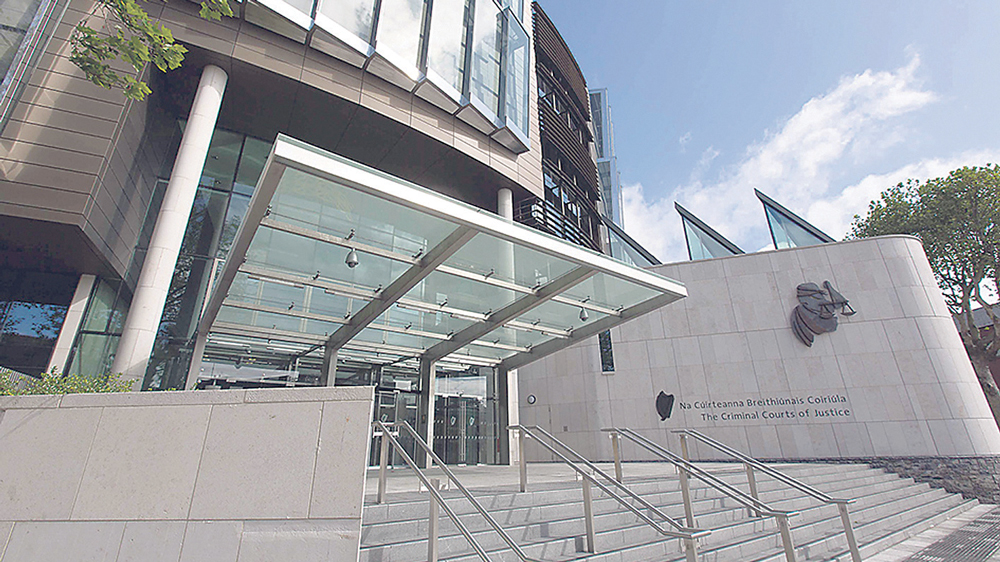
Dublin Circuit Criminal Court
Jail for false imprisonment of visually impaired woman
A MAN who made an “idiotic decision” to pick up a visually impaired woman in his car who believed he was a taxi driver, has been jailed for false imprisonment, reports Eimear Dodd.
Dublin Circuit Criminal Court heard that the woman had been socialising with a friend. They went to a taxi rank in the early hours of May 8, 2022, where they tried for some time to hail a taxi to bring the woman home.
Nicolae Zgherea (30) stopped his car at the taxi rank and spoke to the woman’s friend who believed his response confirmed he was a legitimate taxi driver.
The woman got into the car and after realising there was no taxi licence or meter displayed, she asked Zgherea if he was a taxi driver.
When he confirmed he was not a taxi driver, she asked him to pull over but he continued driving.
She called 999 and put her phone on loudspeaker, with the emergency operator also asking Zgherea to pull over, which he did. The court was told the call lasted just under two and a half minutes.
Zgherea, of Fox Park, Finnstown Abbey, Lucan, Co. Dublin, pleaded guilty to false imprisonment.
David Perry BL, prosecuting, told the court the plea was accepted by the Director of Public Prosecutions on the basis that Zgherea recklessly took actions which amounted to the false imprisonment of the woman.
On Monday, Judge Orla Crowe imposed a sentence of four years. She suspended the final 12 months of that sentence on strict conditions.
Judge Crowe said she was particularly struck by the woman’s
“courage and fortitude” in the face of everything she went through. She noted the significant impact it had on her.
She said given the woman had a white cane with her at the time, it was indicative to anyone that this was someone with a visual impairment.
Judge Crowe also noted that Zgherea had not stopped when the woman realised he was not a taxi driver and asked him to pull over, noting that she had to ultimately call emergency services.
She commended the emergency service operator who eventually convinced Zgherea to pull over and noted that the woman was still in the car when gardaí arrived in a distressed state.
“It was an utterly terrifying experience for a young woman who had the courage and bravery to re-engage in society after Covid,” Judge Crowe commented before she accepted evidence that the woman was unable to work for a period of time afterwards and that Zgherea had
“robbed her of her safety and security”.
Judge Crowe also noted from the woman’s victim impact statement that due to her disability she has to take “a significant leap of faith” and put herself in the hands of strangers and rely on their goodness and kindness.
Judge Crowe set a headline sentence of five years before imposing a term of four years. She took into account mitigating features including the fact that Zgherea had written a letter of
“unreserved apology”, that he has a strong work history and is the father of two young children.
Defence counsel, Karl Moran BL, said that his client made an “idiotic decision” to stop his car with the intention of picking up the woman and her friend for financial gain and had no right to do this.
Mr Moran said his client apologises unreservedly for his actions and accepts he had no lawful right to do what he did.
Counsel noted this would have been a “terrifying experience” for the woman, who expressed its impact
“very eloquently” in her statement.
The court was told the woman is visually impaired and describes herself as almost completely blind when it is dark.
In a victim impact statement read to the court by her brother, the woman outlined that what happened, continues to have a significant effect on her.
The woman said she must trust that strangers will not take advantage of her as she cannot always rely on the vision she has left to read a person’s body language and their intentions.
She said what happened that night has affected her trust in others, her independence and her confidence.
She described enjoying a night out with a friend, the relief of getting a taxi, then her disbelief and panic when Zgherea told her he was not a legitimate taxi driver.
She said her first thought was: “I guess this is just my turn. This is what happens to people like me.”
She said she considered opening the door and jumping out of the moving car.
She said what happened felt much longer than it was and “like it would never end”.
The woman said she experiences flashbacks and questions daily why this happened. “Was I targeted because of my gender, disability, or both?”
She said while she never felt completely unsafe before this happened, she did have an underlying fear of being more vulnerable as a woman and as a visually impaired person.
She said the lifelong consequences for her feel inherently unfair, but she is slowly rebuilding her confidence, trust in others and independence.