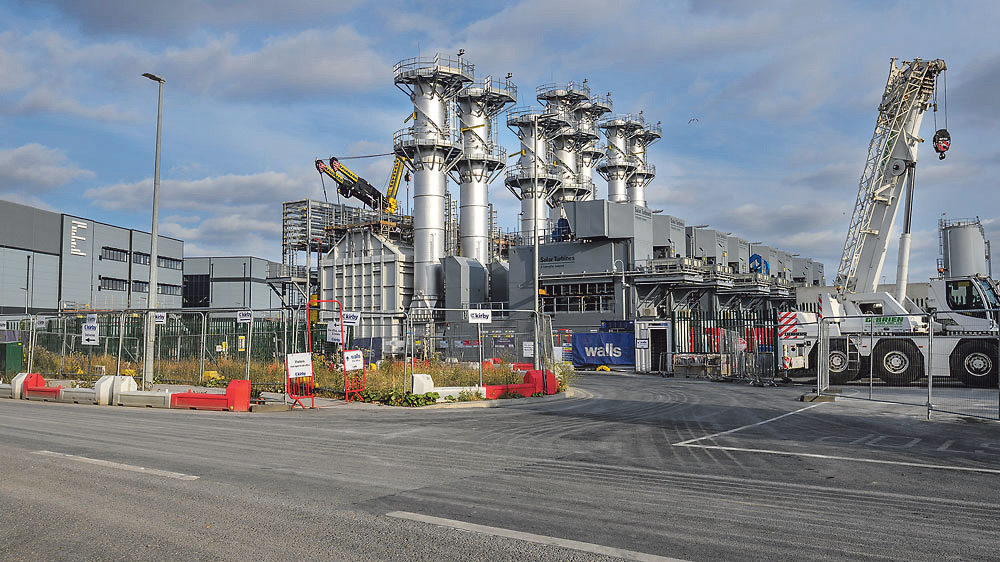
The Echelon data centre on Station Road
The impact of data centres in Ireland is beginning to appear
THE South Dublin County Council administrative area is quickly becoming a hub for data centres, as multinational technology companies such as Google and Echelon continue to locate their data facilities in areas such as Clondalkin and Lucan.
With 32 currently located in the area and planning permission granted for a further ten data centres in the coming years, the full environmental impact is yet to be seen, but research shows that they will undoubtedly affect natural resources.
These facilities rely heavily on fresh water to cool their systems, with many of them connected to the public water supply.
During what was one of Ireland’s hottest and driest summers on record, data centres reportedly used between four and six million litres of water every day during May, June and July this year – during which a hosepipe ban was put in place for the rest of the county.
Electricity consumption is also an area for concern, as the Commission for Regulation of Utilities shared on Tuesday, September 29, at the Joint Oireachtas Committee on Artificial Intelligence.
It was revealed at the Oireachtas Committee that, based on EirGrid’s most recent resource adequacy assessment, data centres and other new technology loads could account for approximately 35 per cent of Ireland’s electricity requirement by 2035.
The impact of data centres in Ireland is beginning to appear, as their share of national electricity consumption has jumped from approximately 5 per cent in 2015 to around 23 per cent in 2025.
Further research carried out by the International Energy Agency shows that large AI-focused facilities can exceed 100 megawatts in demand, with annual electricity consumption comparable to that of around 100,000 households.
New legislation is being introduced to enforce the use of waste energy from data centres to heat local homes and businesses, but more must be done by the government to ensure these large companies do not take advantage of Ireland’s precious resources such as water and electricity.
Greater attention needs to be paid to the ramifications of these facilities on the areas in which they are built, as residents in Clondalkin reported disruption caused by noise from the Echelon data centre, which sits in Clondalkin Industrial Estate.
The Environmental Protection Agency followed up on these reports, only after receiving several complaints from residents and local councillors.
The latest overruling by Comisiún Pleanála to allow for the construction of a 72,400 sqm Google data centre storage facility at the Grange Castle Business Park, despite South Dublin County Council refusing planning permission for the multinational technology corporation, shows that there is no slowing down the construction of these facilities.
These data centres generate a huge proportion of South Dublin County Council’s commercial rates income, making up 22.3 per cent of the overall total.
This figure is equivalent to €35.1m in commercial rates income, up from €31.3m in 2025 and €28.7m in 2024.
South Dublin County Council allocates this money to the upkeep and maintenance of basic public realm services, including footpath repair and maintenance, car parks and traffic management, housing services, parks, sports facilities and playgrounds, as well as several others.
that it is “heavily reliant on the commercial rates income generated by the data centres within its administrative area.”
“Data centres provide a significant source of income and have become an increasingly important source of funding through commercial rates, especially for Local Authorities in the Dublin region.”
As these data centres continue to expand and multiply, it is unclear what the future holds for the areas in which they lay their foundations and just how much of an impact they will have on our resources.
It is clear, however, that greater restrictions are needed on the development of these centres to ensure the impact is kept to a minimum and that the income generated is not prioritised over the wellbeing of the community.
Funded by the Local Democracy Reporting Scheme