
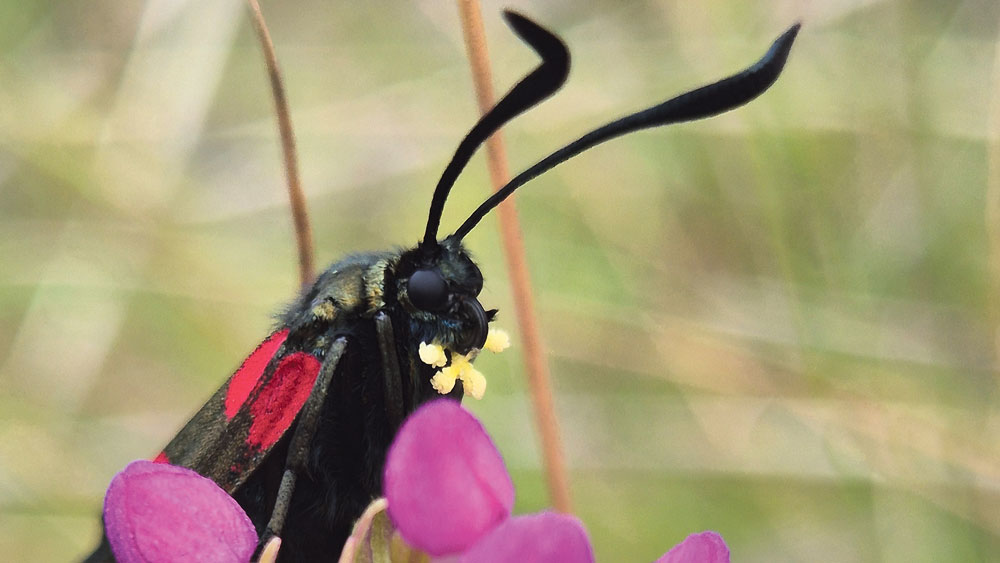
Lumps of yellow pollen are being transferred to other orchid flowers by this day-flying 6-spot Burnet Moth
Nature on our doorsteps: Moths as pollinators
Rosaleen Dwyer is the County Heritage Officer at South Dublin County Council – every week she gives us an insight into the natural heritage around us and the beautiful biodiversity of the plants and creatures.
When we think of pollinating insects, we perhaps focus on the most easily recognised pollinators such as honeybees, bumblebees, hoverflies, and butterflies.
Other insect species, however, are also important such as beetles, flies, and moths. An understanding and appreciation of the role of moths, in particular, is growing.
Some moth species can be seen flying during the day, and these are active pollinators of certain sun-loving flowers.
Most moths, however, fly at night. During the day, these moths hide away from sunlight and predators, and will rest deep inside bushes, under leaves, or in grassy tussocks.
Like butterflies, a moth has a long feeding tube called a proboscis which is curled up underneath its head.
It uses this long feeding tube to collect nectar from flowers that remain open during the night. It is useful particularly for long, tubular-shaped flowers like Honeysuckle.
As the moth feeds, pollen can become attached to its furry body or to its proboscis.
This pollen drops off when the moth moves from flower to flower, and in this way the moth is acting as a pollinator.
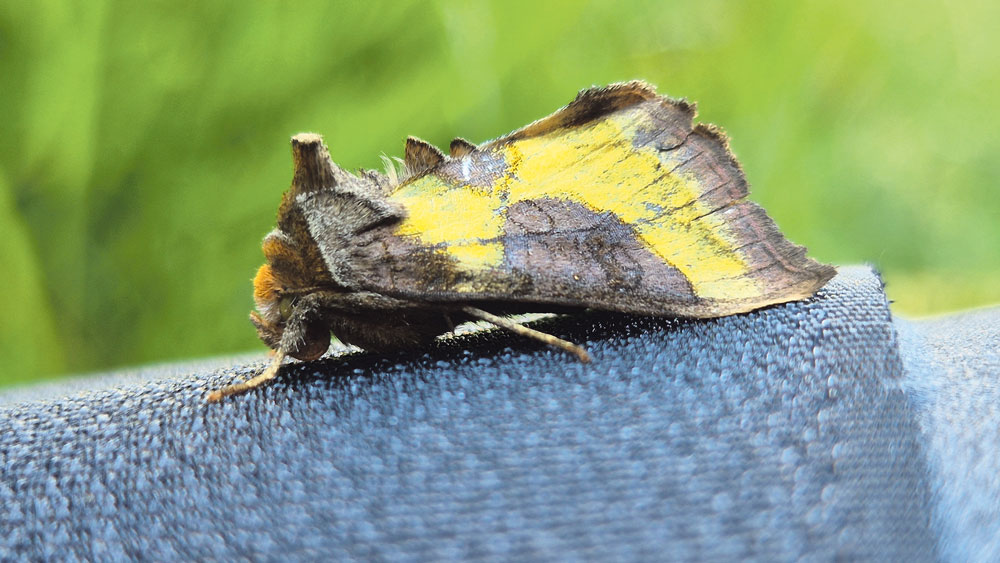
The Burnished Brass Moth sips nectar from the tubular-shaped flowers of Honeysuckle
It is thought that moths evolved to become night-time insects as a way to avoid day-flying predators like birds. As the evolution of insects and flowers has been so closely linked, some flowers also evolved special features to attract moths as night approaches.
These flowers are usually highly scented, which helps attract moths over long distances.
Night-time flowers are often white or cream-coloured, which helps make them more visible to moths in low light.
While moths may have escaped day-flying predators by feeding at night, bats also evolved to fly at night.
These are the main predators of moths, and moths have had to develop highly complicated defence mechanisms to help avoid been eaten by bats.
Interestingly, bats in more tropical countries are also critical pollinators, with some species feeding mainly on the nectar produced by highly scented night-flowering plants.
TAGS Life

