
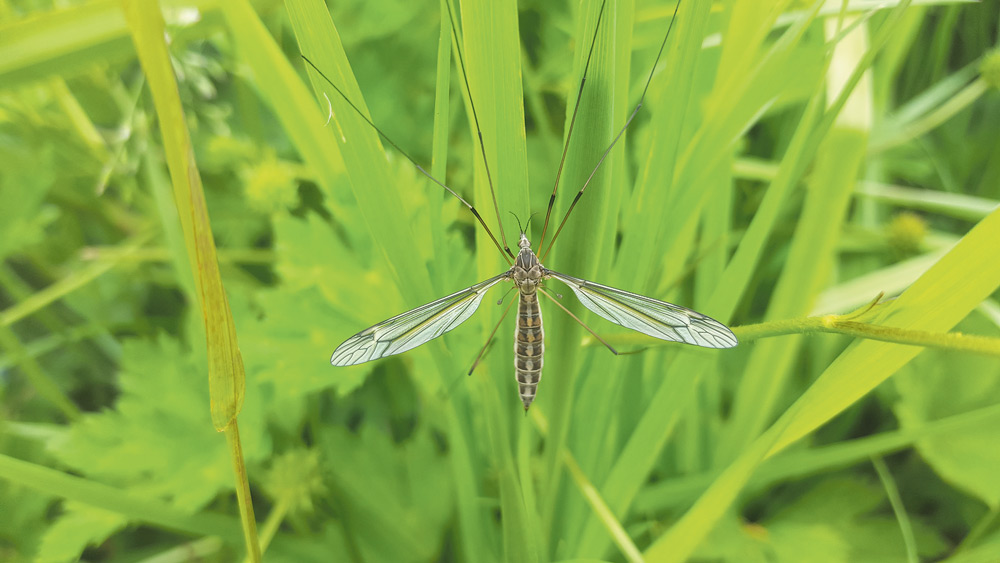
Crane Flies are also called Daddy Longlegs because of their long dangly legs
Nature on our doorsteps: What’s in a name?
Rosaleen Dwyer is the County Heritage Officer at South Dublin County Council – every week she gives us an insight into the natural heritage around us and the beautiful biodiversity of the plants and creatures.
OVER the centuries, names were given to creatures which often described them quite literally.
One good example of this is the ‘Daddy Longlegs’.
This name is often used to identify a large insect with a very slender, stick-like body and six very long, dangly, legs. It is mostly seen in late summer and early autumn, between August and September.
This Daddy Longlegs is a Crane Fly. It is attracted to light, and is often drawn into our homes at night where it can be found dancing around a ceiling light or a side lamp.
In flight it appears clumsy, due mainly to the fact that its wings are relatively short and narrow when compared to the length of its body and its long spindly legs.
Crane Fly adults live for only a few days, and it is thought that most of these do not feed during this time.
Their main aim is to mate and lay eggs for the next generation.
The name Daddy Longlegs, however, has also been given to two other creatures.
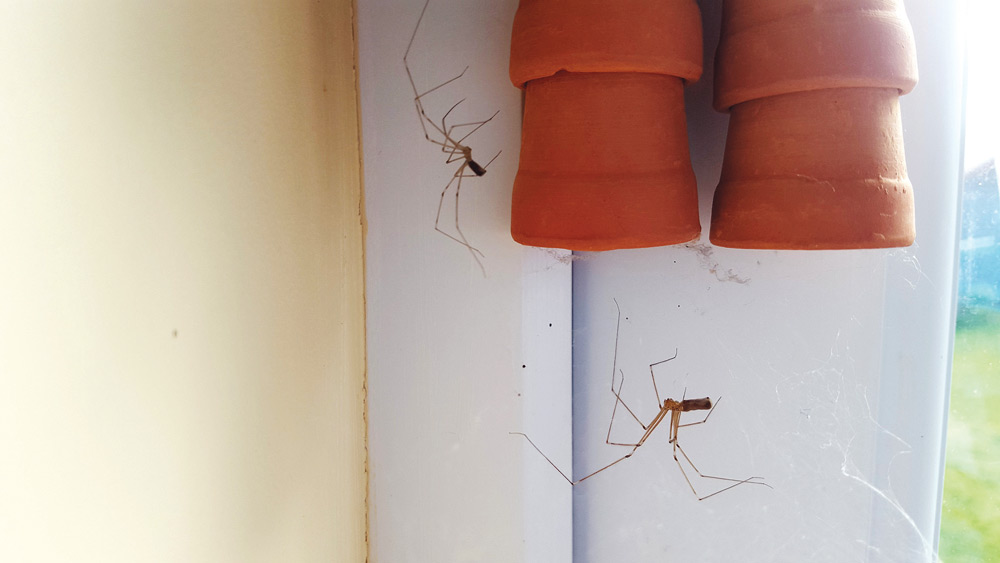
These long-legged Cellar Spiders are sometimes referred to as Daddy Longlegs.
One is the dainty long-legged Cellar Spider that hangs upside down from wispy webs in our houses.
The other is the distant relative of the spiders, the Harvestman, which lives outdoors.
While true spiders have two separate body parts, a Harvestman’s body is condensed into a single unit.
The head, chest and abdomen appear fused into one flattened disc, suspended between really long legs.
Using the same ‘Daddy Longlegs’ name for each of these three species can cause confusion.
In the past, to help avoid identification problems between different species, a scientific system of naming all living things was devised by a Swedish scientist, Carl Linneaus, in the mid-18th century.
This naming system uses two Latin words to describe each creature.
In this way, every living thing has a unique Latin name which helps to correctly identify them, even when their more local, commonly used names might be the same, like with the ‘Daddy Longlegs’.
TAGS Life

