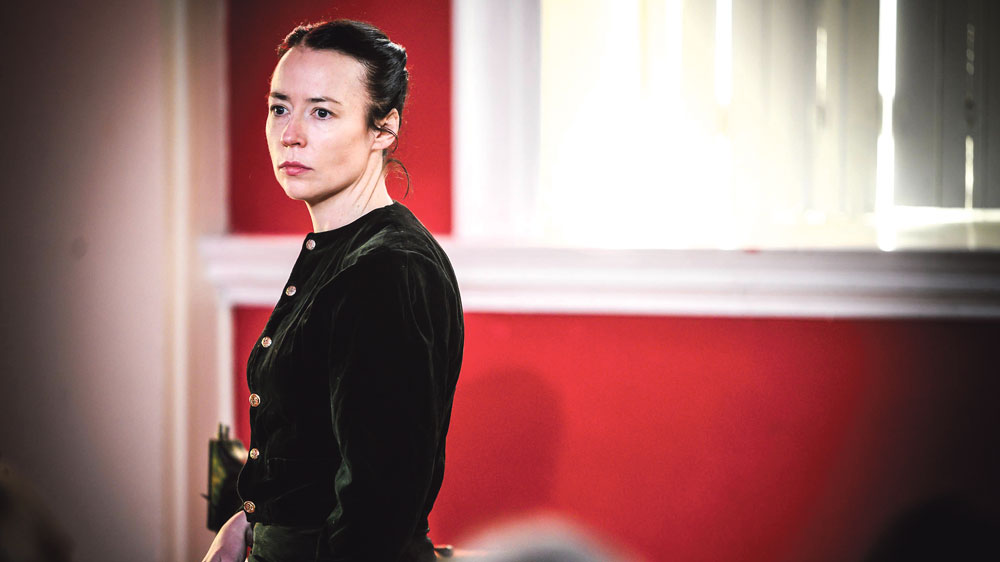
Eve O’Mahony performs multiple characters in her acclaimed one-woman show The Last Witch Bridget Cleary, based on the infamous 1895 killing in Tipperary
Photo Credit: Ian Kenneally
One-woman show explores story behind Ireland’s ‘last witch’
‘THE Last Witch Bridget Cleary’ is a powerful solo theatre performance written and performed by Eve O’Mahony and directed by Carl Duggan.
Inspired by the true story of Bridget Cleary, a brilliant young woman murdered in Tipperary in 1895 after being accused of being a changeling, the play explores superstition, fear, and the treatment of women in rural Ireland.
Blending folklore, history, and psychological drama, the production brings audiences into a world shaped by myth, isolation, and control.
Through vivid storytelling and emotional honesty, the play examines themes of gender and violence that continue to resonate with contemporary audiences today.
This week, The Echo sat down with Eve to discuss ‘The Last Witch Bridget Cleary’, which performs at 1pm and 7pm from October 28 to October 30 in the Civic Theatre.
There will be a post-show Q & A after each performance, and theatregoers are warned that the show contains themes of domestic violence and descriptions of death which may cause distress, with strong language throughout.
Theatregoers are also asked to note that the performances take place in the studio space with unallocated seating, and they are advised to arrive early, as latecomers will not be admitted.
For booking information, visit civictheatre.
What can you tell us about ‘The Last Witch Bridget Cleary’ without giving too much away?
The show is based on the infamous murder of Bridget Cleary by her husband, Michael Cleary, in 1895.
His defence in court was that he believed her to be a fairy/ a changeling.
I play Bridget and a host of other characters and tell the story of how it all came to pass.
How did you come up with the idea for the story of this show? What inspired it?
It’s a true story, but it has so many elements to it—folklore, history, and violence against women.
I had to weave them together without being heavy-handed or obvious.
At first, it was a lot of trial and error; I was throwing everything against the wall, but nothing was sticking.
Then I saw a show at The Abbey Theatre and realised it needed a song.
Now, I am by no means a singer, but adding that music unlocked the character of Bridget. It humanised her and gave her a vulnerability that was lacking in my earlier drafts. It just grew from there.
This is a one-woman show completely written and performed by yourself; how have you approached having this much control over a project? Is it exciting or daunting to perform your own writing?
It’s both. I first performed this version at the Clonmel Junction Arts Festival in the old army barracks.
I was thrilled just to get the opportunity, but then it turned into a completely sold-out run—over 100 people both nights.
Behind a massive black curtain with a bone-dry mouth, the only drinking water I could find was from a rusty old tap untouched since the 1970s. Somehow, I pulled it off.
Ultimately, it feels good to take control of your career in such a fickle industry.
As the producer, I handle the heavy lifting—bookings, contracts, and logistics—but that’s infinitely better than sitting by the phone waiting for someone else to grant permission to perform.
What has been your favourite part of working on this production so far and why?
Definitely the first performance. I didn’t know if it would be a success or not.
If anyone, besides my family, would be seeing it. The set was impressive – we collected old bits of furniture – an old dresser that was over a hundred years old.
My great-grandmother’s sewing machine, an old oil lamp of my grand-aunts.
I remember the dresser going through the streets of Clonmel on a trailer.
What have been some of the biggest challenges involved with this production so far, and how have you navigated them?
Oh, that’s a long list – there are a lot of challenges, but you learn with all of them.
I suppose producing is hard. Every little detail has to be ironed out, but again – it’s important to have agency over your own career.
You also learn to advocate for yourself, which is very important in this business.
There is great support to be had in the arts from the Irish Theatre Institute, but ultimately it’s down to you.
Do you have plans for other projects or performances planned for the rest of 2026 or beyond?
Yes! After this leg, I have more shows set for next year.
You always have to have about 100 irons in the fire in this business, but it all depends on the “F” word – funding…
Who would you like to thank for helping to make this show possible?
I’m very grateful to all the festivals and venues that gave me my start when this show was brand new.
They’re vital to emerging artists—just giving us that initial chance is huge.
Cal Duggan, my director, who is a great support – the smallest bit of advice from her goes a long way.
I’d also like to give a big thank-you to The Civic Theatre.
Dublin really is the epicentre of Irish theatre, and I’m delighted to be putting my first show on in The Civic. They’ve given me a lot of support and advice in promoting the show. So many thanks to them.
And then, of course, there’s my mother.
She was there from the beginning.
She’s an English teacher, so every time I had a new draft, she was great with the advice.
The advice being that it wasn’t good enough. When I finally wrote a good version, we both breathed a sigh of relief.
She’s painted dressers, sourced tables, and helped me buy last-minute props when I’ve forgotten them.
Once, I was doing a show in Nenagh, I realised I was missing my hat, which is a huge part of my costume.
We ran straight to a charity shop, then a pound shop, and cobbled one together.
It turned out fab, and I still use it to this day. So a big thank-you to my mother, Marian.