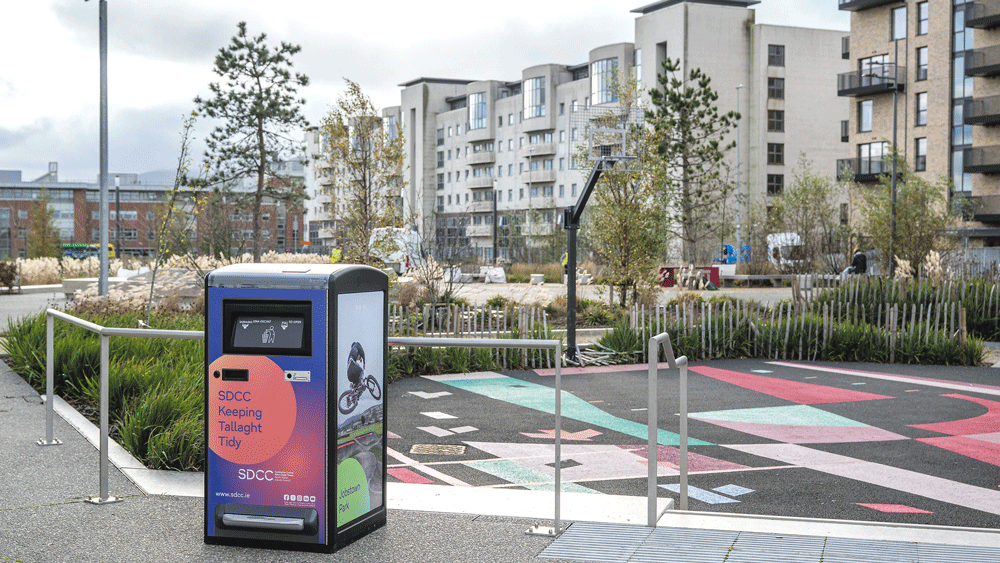
The new bins rolled out across the county
Only eight submissions made for litter management plan
A new draft litter management plan for South Dublin has been praised for its “strong ambition”, but responses show how bad the current situation has become in the county.
The new draft litter management plan from the local authority outlines an intent to use CCTV to monitor illegal dumping, the undertaking of street cleaning programmes with daily inspections, improved visibility of litter wardens and promotion of anti-litter messaging, including anti-bonfire messaging.
In 2024, the council revealed that it was spending on average of €1.4m every year to combat the illegal dumping of waste.
The plan also states an intention to provide continued support of community groups such as Tidy Towns groups.
Eight submissions were made in response to the draft plan during its consultation period, many welcoming the improvements outlined in the document.
However, many lamented the lack of services currently available and hoped that this new draft plan can evolve into something that will change the current litter management scene in South Dublin.
One submission called for more long-term tactics to help tackle issues such as illegal dumping.
The author described the dumping that occurs near their residence as “continuous, predictable and well-known to the council” and stated that it has been going on for over a decade.
The author called for CCTV presence: “Short term clean ups alone are not working. Waste is often dumped again within days.
“Without deterrence, the same individuals continue to use this location as a convenient dumping point.
“The absence of CCTV or targeted enforcement has created a perception that this area is low risk for offenders, which encourages further dumping and contributes to environmental degradation, vermin, and reduced community morale.”
They added that the current situation undermines South Dublin County Council’s stated goals of a clean environment and the maintenance and enforcement involved with it.
Another author called for increased awareness around the litter warden service and noted that their local one is in need of more help – they stated that the service number should be widely known across the county and more wardens should be hired.
One author called for more recycling centres to be established in South Dublin to accompany population growth in several areas like Adamstown and Saggart.
The submission reads: “Whilst a great amenity it is not easily accessible to all people within SDCC boundary, given the size of the area.
“There should be 3/4 additional facilities close to population centres with SDCC boundary.
“These facilities do not have to be as complex as the one in Ballymount, but it should be close to population centres.”
Several submissions discussed the litter bins in South Dublin, with one calling for a public survey, one calling for more and another calling for ‘tagging’ to be carried out, akin to Dublin City Council.
These ‘tagged’ bins would be adorned with a QR code, so that issues can be reported in real time.
The enforcement of litter management ideals was put at odds with planning goals by several authors as a reason for the need for more bins across the county.
One author made an observation that the current draft “focuses heavily on penalising illegal dumping” and requested basic waste infrastructure to become a more central part of the plan.
This author singled out Adamstown: “Because Adamstown is experiencing city-centre population densities but is only being provided with suburban-level waste infrastructure, casual littering is inevitable at high-footfall transit nodes.
“While enforcement is necessary, it cannot replace the physical provision of bins. We request that the Enforcement & Regulation strategy acknowledges that in high-density SDZs, the installation of restricted-aperture smart bins at bus stops is a necessary first step to prevent casual littering offenses before they occur, reducing the reliance on TidyTowns volunteers to clean up the resulting waste.”
The submissions made on the draft plan will now be considered and revisions will be made before it is put forward to elected members of the council.
Funded by the Local Democracy Reporting Scheme.