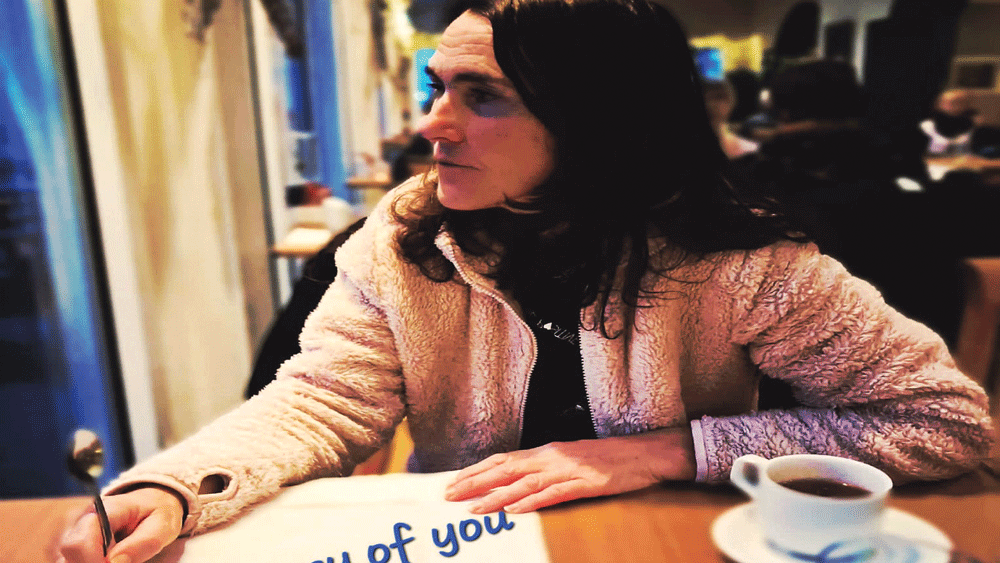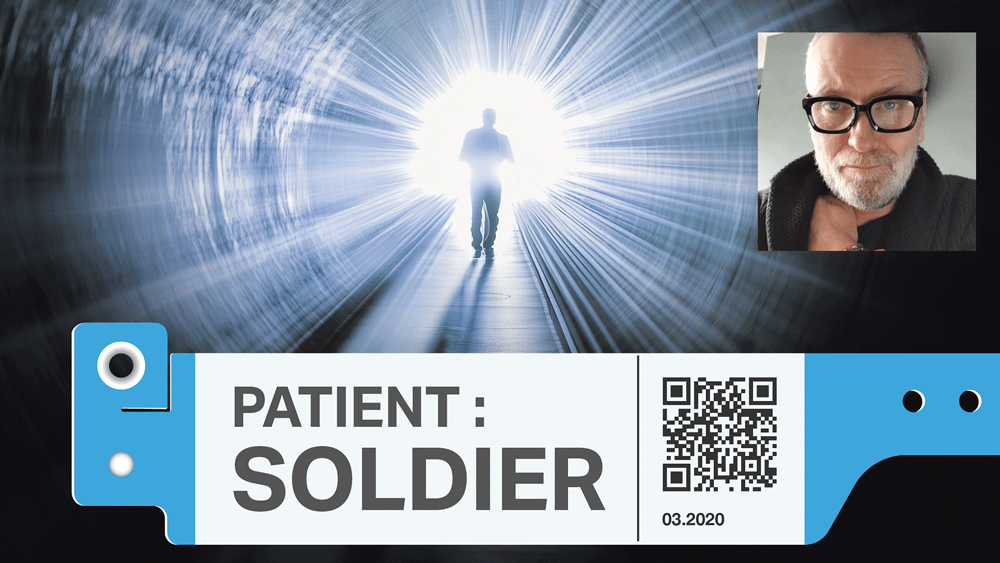
Patient Soldier will perform at the Civic Theatre and (inset): Barra Fitzgibbon
Patient: Soldier an Irishman’s fight for life and love during pandemic
‘PATIENT: Soldier’ follows Dr Reaper, who steps into the spotlight as both witness and guide through an Irishman’s fight for life and love during the early days of the pandemic.
At its heart lies a profound belief that words, connection, and sheer will can tip the scales between survival and surrender.
A love letter to the health service, the play captures the heartbreak and absurdity of life on the frontline.
Set in an overwhelmed hospital that’s part battlefield, part comedy club, and part confessional, it’s a warts-and-all portrait of courage, compassion, and the madness of medicine under pressure.
Hilarious and heartbreaking in equal measure, ‘Patient: Soldier’ exposes the chaos, courage, and absurd humanity of those fighting to hold the line and reminds us that even in the darkest moments, laughter and love endure.
This week, The Echo sat down with writer Barra Fitzgibbon, whose show ‘Patient Soldier’ performs in the Civic Theatre each day from April 27 to May 1 at 8.15pm, as well as a lunchtime performance at 1pm on April 29.
I understand ‘Patient: Soldier’ is based on your own personal story of being the first COVID ICU survivor in the UK; how did the inspiration to write a play based on this experience come to you?
I wrote ‘Patient: Soldier’ as part of my recovery rather than any grand creative plan.
The day I returned home from ICU, I began a blog to process what happened.
Writing was deeply cathartic and gave me a sense of control after such a powerless experience.
I couldn’t stop; the memories, characters, hallucinations, and the strange mix of comedy and tragedy kept surfacing.
Gradually, I realised the story had a strong theatrical shape.
Theatre felt like the natural home for the intensity and humanity of that frontline experience.
What began as a private piece of writing ultimately evolved into a play meant to be shared with the public at large.
What has been your favourite part of working on this story, and why?
Workshopping it with the medical staff of the ICU who are actual characters in it. So much fun, because I’m depicting the good and the bad; not all of them were nice. Workshopping any play is vital.
I wanted to make sure I remembered the medical terminology right, and that’s why they were brought in.
But when it’s being read and the real Nurse Andrew is watching my depiction of Nurse Andrew, that’s a moment that stays with you.
Luckily, they all gave it a roaring seal of approval.
What were the biggest challenges you encountered while writing this play, and how have you navigated them?
I had never written a play before. The blog had 25 characters in it, and I didn’t know where to start.
So I brought in Katherine White as a co-writer. (Katherine also happens to be the actor, the only actor, as it’s a one-person play).
She took it away for a year and began shaping it into something that might truly work on stage.
She distilled the characters down to six, developed the narrative, and gave it a clear dramatic arc, making the whole process look easy.
Thank god for Katherine. Secondly, the audio pieces in the play are incredibly challenging to hear.
During my time in hospital, my wife Jen recorded conversations with consultants and nurses and shared them with family in Ireland.
Listening back to my wife’s and children’s fear and emotion is very difficult.
But I realised how vital those recordings were, both to the story and as a historical snapshot of those uncertain early days of March 2020.
What was it that made you choose the Civic Theatre as the venue for the premiere of this play? Have you performed in Tallaght before?
Never performed in Tallaght before, as it’s my first play.
These things tend to happen from meeting people and feeling the vibe. Donal Shiels, Artistic Director of The Civic, is just a lovely fella, easygoing and warm.
I immediately felt a connection. We had a quick cuppa, and it just felt right.
I knew he’d look after it. ‘Patient: Soldier’ is important to me, and I can be a little protective.
Donal got that straight off the bat. He was also quick to offer it a weeklong slot; that always helps.
What messages are you hoping audiences will take away from ‘Patient: Soldier’, and why?
The play is very immersive. During its West End run, the best thing was to see its impact on audiences.
To hear people’s reactions and listen to their gratitude because ‘Patient: Soldier’ gives them a space to process and perhaps grieve a time we haven’t fully been allowed to.
I’m hoping Irish audiences will feel the same.
This is a story of hope and survival and a chance to take something positive from such an extraordinary period in history.
It feels important.
If we’re going to learn lessons from 2020, we must create a space where we are not constantly looking back in fear.
Good things happened alongside the horrific ones, especially human connection and what about the heroes of the health service?
This play honours them.
Also, we’re having a Q&A after each performance in The Civic, which gives the audience a real opportunity to dive in deeper.
That’s quite a rare opportunity, to have the real people depicted in the play ready straight after to field any questions.
What is next for you after the tour ends in Bray on May 26? Do you have any more projects planned this year, or will you be taking a well-deserved rest first?
Edinburgh Festival 2026 in August. Not much of a rest.
I never expected it to get this far, but it just keeps going.
There’s an appetite for it, and as long as there is, we’ll get it on.
Who would you like to thank for helping you make this play possible?
Where do I start? Sponsors: The Skeff Bar, Electric Galway, Tweed Wealth
Management, Irish Community Services in London, Capital City College. The crew: director Daniel Clarkson, light designer Adam Foley, stage manager Bea Adomaityte (who works at The Civic).
My wife Jen and kids Jacob and Robyn for the emotional support and the creative ideas they brought to the script.
But I’ve left out the actor and co-writer Katherine White for a reason.
Final word has to go to her. She’s about to embark on a one-person play, playing all six characters across 12 performances all over the Island of Ireland.
Without her talent, there’d be no show, no story to share.
Thank you, Katherine White.