Jack Harte
‘The Sailor’s Dream’ on a mission to discover the Northwest Passage
Sir John Franklin set out in 1845 with the two best ships of the Royal Navy and 129 crew on a mission to discover the Northwest Passage, a sea route from Europe to Asia between the Arctic and the Canadian mainland.
They disappeared without trace. Not a single survivor returned to tell what happened.
Driven by the persistence of Franklin’s indomitable wife, search parties gathered fragments of evidence, but not enough to give a satisfactory explanation of what happened.
The Irish involvement in the expedition and the search was considerable and fascinating. Today a dedicated Irishman continues to search for Franklin’s grave, the last chance to throw light on his fate.
Through story and song, history and speculation, Jack Harte brings this intriguing episode of polar exploration to life again and takes the audience on its voyage of exploration, especially into the enigma of Lady Jane Franklin.
This week, The Echo sat down with Jack to discuss ‘The Sailor’s Dream’, which performs in the Civic Theatre on March 3 at 8 p.m.
Could you please share some insights about ‘The Sailor’s Dream’ while keeping the key details under wraps?
While most people are familiar with the story, the mystery remains unsolved. In 1845, the British Navy mounted an expedition to find a path to Asia along the north coast of Canada, between it and the Arctic.
They thought there was a passage there, and if they could get the ships through it, it would be cheaper than going around Cape Horn.
They’d been trying for centuries, but this was the big effort, and they put John Franklin in charge.
Gave him two ships and 129 men, and they sailed into the Arctic and disappeared.
Nothing came back ever. About 10 years ago, they discovered the two ships and hoped to get information about what happened to the crew, but nothing came of it.
They found no kind of further evidence

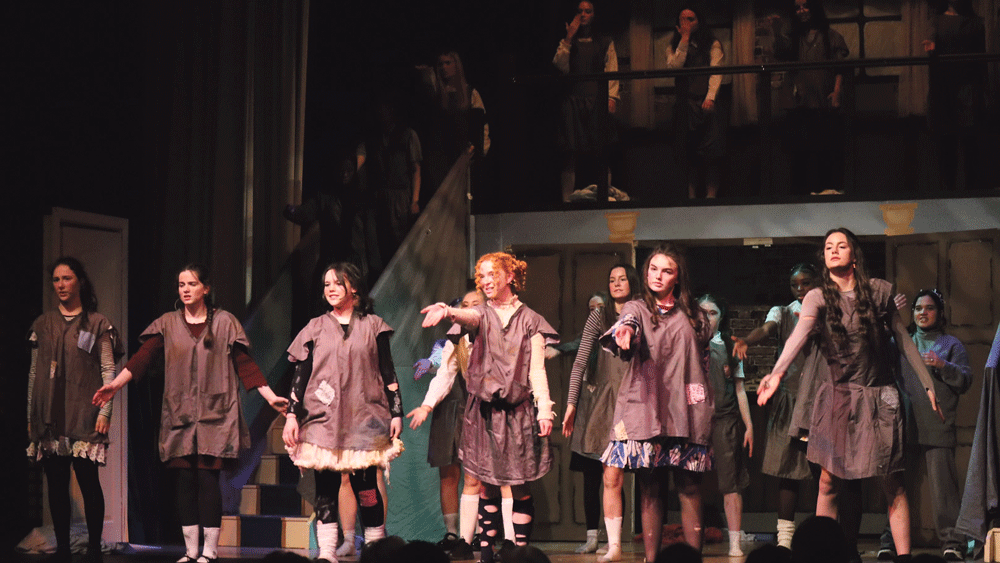
Actors from ‘The Sailors Dream’
What inspired you to write this play?
A book by my friend Kevin Cronin inspired me to write this play.
Kevin, one of a group of sailors based in Mayo, played a significant role.
They set sail from Westport to do the Northwest Passage.
These lads sailed through it in 2004; they mounted this expedition of their own, a private, small expedition on the small yacht, and managed to sail through it.
Over two summers, they succeeded in sailing their boat back by the Northeast Passage.
They became the first boat to have actually successfully circumnavigated the Arctic and to have gone over by the Northeast Passage, a huge achievement.
Kevin Cronin was one of the crew of that ship. After that successful circumnavigation, he became interested in the whole Franklin episode because he had come across it when they were sailing through.
Kevin and another friend of his, another enthusiast, are exploring and trying to find out about Franklin.
They have continued their search right up to the present day for Franklin’s grave.
Kevin wrote a book about it, and Anthony Fox, the director of the New Theatre, showed me the book; I read it, and he asked if I could write a play based on it.
What can you tell us about the play’s characters?
The second-in-command was a man named Frances Crozier from Banbridge, County Down, who should have been the commander in charge but refused the position.
He was a very famous explorer, but when Franklin was appointed, he agreed to be second in command and help out.
There was another guy, one of the most successful of the people searching for evidence, a fellow called Leopold McClintock from Dundalk.
He was employed by Lady Franklin to find evidence of her husband’s expedition.
His team discovered a trail of tragedy, including corpses and documentation left behind by the men.
The only record found was a canister signed by Crozier, indicating Franklin’s death and the last men’s plan to head for the Canadian mainland.
Captain Robert McClure’s mission was to explore the Bering Strait (between Alaska and Russia) to find Franklin.
He continued his journey in that direction, heading eastwards from the Russian side towards Canada.
Eventually, he found himself ensnared in the ice and had to abandon his ship.
However, he and his crew persevered over the frozen water until they encountered searchers approaching from the west.
He claimed that he had discovered the Northwest Passage because he had walked over it.
When they went back to London, the Admiralty were so totally cheesed off of the whole story and all the money they spent and all the lives that were lost that they declared, “Yes, this is the guy who discovered the Northwest Passage,” and they gave him a knighthood and all kinds of prizes.
Tell us more about Lady Franklin and her role in the play.
The mass production of newspapers was a pretty new thing.
They were cheap to produce in the 1840s and 1850s, so everyone could read them, thanks to the national schools set up in the 1830s.
Ordinary people could all now read the newspaper, and Lady Franklin was, as far as I can see, one of the first to realise the potential of moulding public opinion.
So she wouldn’t let the Admiralty declare that “Look, this mission is over.
We can’t do any more.” Knowing she had the people under her control, she kept up the pressure, insisting, “No, Lord Franklin is up there; he may still be alive.”
Such was her power of persuasion that the government was afraid of her.
The Admiralty were afraid of her, and they just kept mounting these search parties.
She made appeals through newspapers, articles, and letters to the editor, receiving large sums of money to finance further search parties and other expenses.
She later used this money to fund statues of Franklin. She basically made him into a hero.
What else do you have planned for 2026?
Approximately six projects remain unfinished. I have until the end of April to write a new play for the New Theatre.
Then early next year, I’ll have a novel on the boiler as well; I’m trying to finish that.
I am also working on numerous other projects. I am never short of something to do.
Who would you like to thank for helping you with this production?
There are some people who are totally central to its production.
First of all, Anthony Fox in the New Theatre. He was the one who commissioned me to write it.
Kevin Cronin, then, was the guy who sailed around the Arctic and is still searching for Franklin’s grave.
I’ve made him a character in the play.
The New Theatre is a terrific little theatre with a small company, and they do an amazing amount of work to promote new plays.
I want to acknowledge that this play and many others would not exist without them.