
Stock image
20% of car parking in new developments must be equipped with charging points
Sufficient electric vehicle charging infrastructure is being embedded in all newly planned housing developments within the county, according to SDCC.
This is fulfilled through a combination of “minimum provision, forward-looking infrastructure design requirements, and ongoing public charging investment”.
SDCC’s Development Plan specifically provides EV charging infrastructure for new residential developments as follows:
“All new multi-unit residential developments shall provide a minimum of 20 per cent of car parking spaces equipped with EV charging points, with ducting and infrastructure provided to facilitate the future provision of EV charging points to the remainder of spaces.”
In practice, it has come to light that the 20 per cent target is currently exceeding overall demand and that it must be noted that on-curtilage parking spaces can connect an EV charger to the owner’s house supply.
The percentage of chargers needed in the future may not exceed the current 20 per cent target, as a single shared charger location can provide for multiple cars, which is much more efficient infrastructure use.
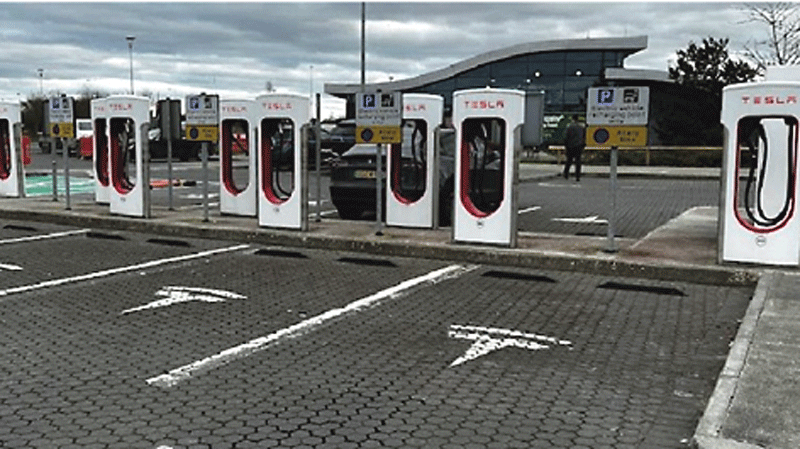
As well as residential charging provisions, public and commercial charging solutions will also be included in the forthcoming County Development Plan.
It is important that “off curtilage or shared car parking spaces charging must be installed by competent providers and managed by the OMC’s with professional monitoring and maintenance protocols in place.”
Currently, private power cables are not allowed in public or shared areas and there is no national guidance framework to support such arrangements.
In residential estates being considered for Taking in Charge, the presence of unauthorised private EV charging installations including public footpaths and shared parking spaces may pose an issue for the Council.
Operational, safety and liability concerns in relation to infrastructure for which the Council would subsequently become responsible may be introduced if such installations are allowed to remain.
The removal of unauthorised private EV charging installations is necessary to facilitate the proper completion of the Taking in Charge of estates process, to ensure compliance with statutory standards.
In alignment with current national policy and best practice guidance, SDCC will consider local needs, spatial planning objectives, and ongoing engagement with ESB Networks and other relevant agencies before rolling out further EV charging infrastructure.
Funded by the Local Democracy Reporting Scheme

