
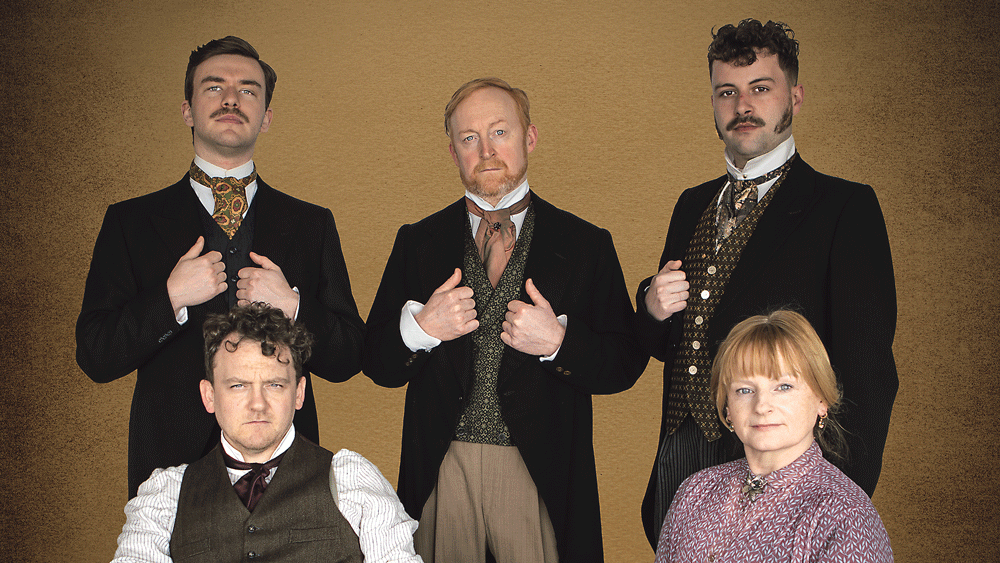
Robbie O'Connor, Peter Rothwell, Karl Quinn, Jack Gavin and Niamh McGrath in Miasma
Photo by Carol Cummins
‘Miasma’ is a medical detective story to be performed at TUH
‘MIASMA’ is a medical detective story set in the London of Charles Dickens’s time.
It is the story of a lone doctor who thinks he can stop the most frightening and fatal disease of his day: Cholera.
But to do so he will have to defeat popular superstition, the medical profession, the political and media elites… and the disease itself.
This is a story about bad science and good science… about groupthink and dissent… about insiders and outsiders… and about one man taking on the system.
Told with five actors playing multiple parts in a fast-paced, comic format, ‘Miasma’ illuminates key challenges still at the heart of science and public health today.
Starring Jack Gavin, Niamh McGrath, Robbie O’Connor, Karl Quinn, and Peter Rothwell, this production will be presented by Verdant Productions in association with the Civic Theatre.
The 60 minute show is funded by Taighde Eireann and will be performed offsite at the Trinity Lecture Hall of Tallaght University Hospital.
This week, we sat down with writer Colin Murphy, whose production of ‘Miasma’ can be viewed at 7pm on May 7; check the Civic website for booking details.
What can you tell us about ‘Miasma’ without giving too much away?
Miasma is a medical detective story set in the London of Charles Dickens’s time – a London that was filthy, incredibly unhealthy, appallingly overcrowded (it was the first city in the world to reach 2 million people), and which STANK.
It’s the story of a lone doctor who thinks he can stop the most frightening and fatal disease of his day: Cholera.
But to do so he will have to defeat popular superstition, the medical profession, the political and media elites… and the disease itself.
It’s a story about bad science and good science, about groupthink and dissent, about insiders and outsiders and about one man taking on the system.
In this age of conspiracy theories, misinformation and algorithmic outrage, how do we know when to “trust the science” – and when to trust the scientists?
Miasma illuminates key challenges still at the heart of science and public health today. It’s told with five actors playing multiple parts in a fast-paced, comic format.
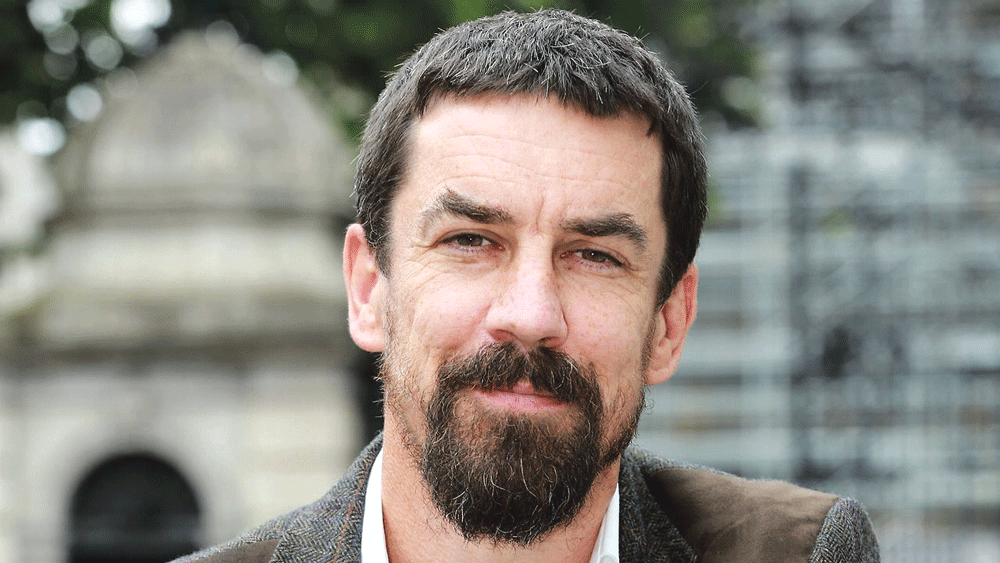
Colin Murphy
Photo by Carol Cummins
What inspired this story?
Covid! I wanted to find a way to read, think and write about pandemics and public health without having to go over the Covid story again.
When I found this story of a different pandemic in the 19th century, I realised it could be a way to reflect on all we had experienced but without causing PTSD!
And I grew fascinated by issues of trust in science – and trusting “the science” – and how that has become an urgent public health (and political) issue today.
What processes have been involved in this production?
Reading. Researching. Writing. Networking with scientists and academics.
Writing funding applications. Being turned down for funding.
Rewriting funding applications and resubmitting them.
Getting the funding! Building a unique network of institutions and venues to tour to.
Building relationships with schools, universities and also a whole range of community groups in order to find a new and diverse audience.
Promoting it online and in the press and by word of mouth. Designing the costumes, props and lighting. Composing the music.
Directing the actors in rehearsal. Physically moving the play into the venues.
I could go on!
What has been your favourite part of working on this show so far and why?
We’re bringing it to a fascinating variety of spaces – including Tallaght University Hospital.
I’ve never put on a play in a hospital before!
The venue becomes like the 6th character – the play changes subtly but in exciting ways to respond to the space and its history and its own unique audience mix.
What have been some of the biggest challenges you have encountered so far in this production, and how have you navigated them?
Bringing it to those places! Everyone is different – different shapes, sizes, acoustics, and lighting – and the cast and crew have to rapidly adjust to fit the play anew to each space.
And most of the venues aren’t used to dealing with public theatre audiences, so the company, Verdant, has to work with them to work out everything from box office to directions to rooms for the cast to change in.
What is next for you? Do you have plans for other projects in 2026?
I’ve a collection of plays, titled (egotistically) ‘Colin Murphy’s Political Plays’, just out.
Available from all good book shops!
It contains five of my plays about Irish political history, charting the first 100 years of the republic, from the Easter Rising through to the Bailout.
The Easter Rising play, ‘Inside the GPO’, is having a public reading in New York in June, which is exciting.
I’ve a small play (half an hour long) called ‘The Weak Suffer What They Must’, which is an adaptation of an ancient text about war and peace by Thucydides (called ‘The Melian Dialogue’), which we pair with an expert-led debate about geopolitics as an event – we’re hoping to do that at various festivals and venues this summer.
And lots of other scripts at various stages from germination to development to fundraising.
Who would you like to thank for helping you with this production?
Research Ireland’s innovative Discover programme – which funds public engagement with research – is what has enabled this all to happen.
Prof Gerardine Meaney in UCD leads the academic team that has made the project happen.
(As well as the play, we have post-show discussions and workshops in many of the venues, and there’s to be a short story challenge for students later in the year.)
Verdant Productions has produced this extraordinary tour.
And, as director, Sam Cade is the lead artist responsible for what you see on stage.
The cast and designers and crew are a mixture of top-flight professionals at the top of their game and younger emerging talents – a thrilling mix.
TAGS Life

