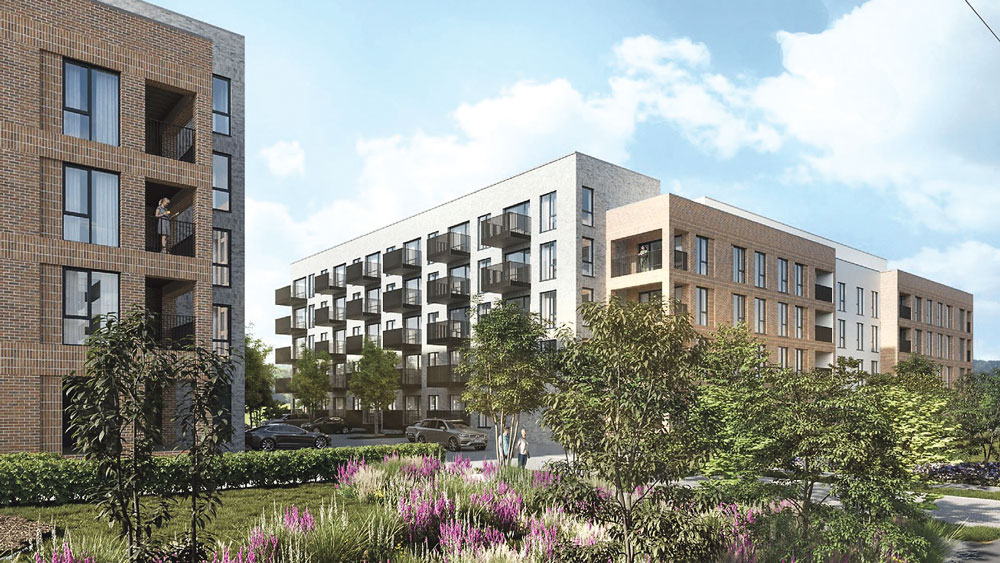
An artists impression of the development
Council refuses permission for 403 home development
AN application seeking permission to develop over 400 residential units at the Securispeed Logistics Site in Clondalkin has been refused by South Dublin County Council’s Planning Authority on seven grounds.
Thornmeadow Developments Limited applied for permission in August for the construction of 403 apartments, including 24 studio apartments, 230 one-bed and 149 two-bed apartments and five three-bed houses.
The planning proposal consisted of a nine-storey mixed-use building alongside three five-storey apartment blocks as well as five houses, with 202 car parking spaces and 752 spaces for bicycle parking.
SDCC listed several reasons for refusing permission, including the impacts the development would have on the wider community and the suitability of the site.
The Council considered the recommendation from the Natural Water Department to refuse permission on the basis of flood risk, stating that “adequate detail has not been provided in relation to measures which would counter the risk of flooding in this area.”
The lack of childcare facilities in Clondalkin was also listed as a reason for refusal, as the development includes 154 family-sized units but fails to “provide adequate childcare facilities to serve the development.”
With the “limited existing childcare capacity in the area and the absence of sufficient justification for the proposed reduction in childcare provision”, a creche facility with a capacity of approximately 41 children should be provided, according to the Planning Authority.
The development was a point of contention for many Councillors and Clondalkin residents, with 17 submissions received. The submissions cite concerns in relation to traffic, privacy, sunlight, and the impact on the wider community, which were taken into account by the Planning Authority.
Councillor Eoin Ó Broin told The Echo of his “surprise” following the Planning Authority’s decision, stating that the two grounds for refusal that stand out are the “lack of daylight for some of the units and the issue around there being only one way in and one way out of the development, and how that would impact the surrounding road network.”
The only access to the proposed development is via Oakfield Road, which is deemed a
“currently substandard and poorly configured access road”. The Planning Authority stated that the proposed transition between the development and the existing road appears to have been
“haphazardly arranged without alignment of landscaping and pedestrian and cyclist facilities.”
If this access point were to serve the proposed development, it would be “prejudicial to road safety” and “would provide a poor design standard and environment for a high-density residential development” and therefore be
“contrary to the proper planning and sustainable development of the area.”
The applicant’s failure to demonstrate that key areas of public open space and residential units will receive adequate levels of sunlight was also listed as a reason, with evidence proving that some units received 0.0 hours of sunlight in March, with a further 24 units receiving “inadequate levels of sunlight.”
The Planning Authority communicated that details regarding vehicular entrances for the car park and inaccurate traffic figures and queue lengths on the Ninth Lock Road would create a traffic hazard due to the deficiency in the road network serving the area.
The car parking ratio for the site of 0.49 is considered “to be too low to adequately serve the development” according to the Planning Authority, likely resulting in “displaced and haphazard parking behaviour in the surrounding area.”
The Planning Authority also refused to grant permission in the absence of an Environmental Impact Assessment Report, which was not submitted by the applicant.
Funded by the Local Democracy Reporting Scheme