Many of the objections are against the rezoning of St Edmundsbury
Major opposition to plans to rezone 157.5 hectares of land
There has been major public opposition to council plans to rezone up to 157.5 hectares of land across South Dublin for residential development.
South Dublin County Council’s public consultation on the proposed variation to the South Dublin County Development Plan 2022-28 closed on Friday, March 13, with over 1,300 submissions and objections lodged.
Over-development, loss of open green spaces, strain on existing infrastructure such as schools, roads, and public transport and conflict with existing zoning objectives are just some of the issues raised in the 1,306 submissions on the council’s online portal.
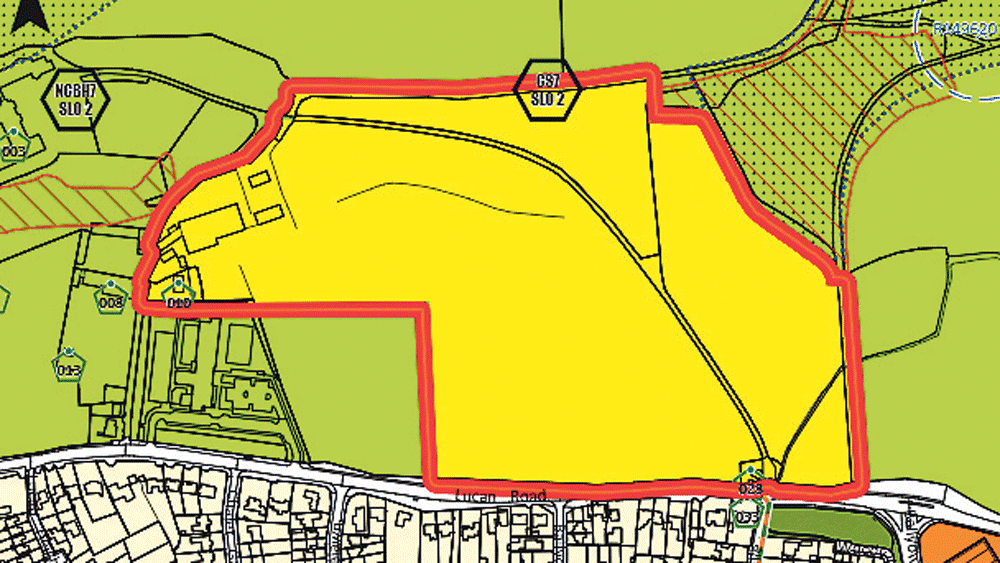
The majority of submissions were in relation to sites around Lucan, including the site proposed within the grounds of St Edmundsbury Hospital which was the subject of 676 submissions – over half of the total amount.
Many of the objections against rezoning the St Edmundsbury site highlighted its significance as a green space within the Lucan area, and the fact that it is currently zoned as “High Amenity – Liffey Valley (HA-LV) to protect the area’s special landscape, enhance the Liffey Valley, and to preserve ecologically sensitive areas from intensive development”.
Many called for the site to be preserved as “green lungs and space for relief and wellbeing in an increasingly built-up part of Lucan” with one submission calling for the creation of a “Liffey Valley National Park”.
The submissions for St Edmundsbury also highlighted the already “significant pressure on infrastructure and public services” within Lucan.
Another Lucan site that was the subject of a significant number of objections are lands adjacent to the Foxhunter pub on the N4, which received 107 submissions.
Many of these noted that two previous County Development Plans had kept the zoning of the 1.18ha site as Retail Warehousing “because this land and the road infrastructure surrounding it isn’t suitable for residential development”.
“Maintaining a zoning of Retail Warehousing on this land offers future employment opportunities within Lucan, negating the need for long commutes outside of Lucan,” a number of them said.
Many of the 88 submissions that were tagged as General Comments also focused on the fact that sites in Lucan account for 64% of the proposed sites, and concerns that the area would become over-developed, as it “has borne a substantial share of housing delivery for the entire county”.
The former hotel grounds and golf course at Finnstown Castle was also the subject of over 15% of the total submissions, with 197 objections raised.
Many called for the 17.94ha site (with the potential for over 1,000 homes) to instead be rezoned as High Amenity to protect “essential green space in this densely populated and traffic congested area”.
There were also a number of objections to proposals to remove specific zoning that designates a small site at Stocking Avenue, Ballycullen as a school, and rezone it as residential to provide just 90 housing units.
“While we recognise the need to provide housing, this level of development must be accompanied by the necessary social and community infrastructure to support sustainable communities,” one of the 32 objections relating to this site read, also highlighting an “acute shortage of school places” in the Ballycullen area.
A handful of submissions marked as General Comments also appear to be from developers who had suggested their sites for rezoning during SDCC’s original callout to “the public, landowners and homebuilders” for potential sites in October 2025, but had not been included by the council on the final list.
These submissions re-suggested their sites be included on the list to be rezoned as residential, and include a site in Lucan Hills Industrial Estate, agricultural lands in Blessington and Robin Hill in Kiltipper, and a rural site to the north of Newcastle village.
All submissions will now be reviewed and subject to a Chief Executive’s report, which will be shared with councillors and voted on at a special meeting of South Dublin County Council in the coming months.
Funded by the Local Democracy Reporting Scheme