
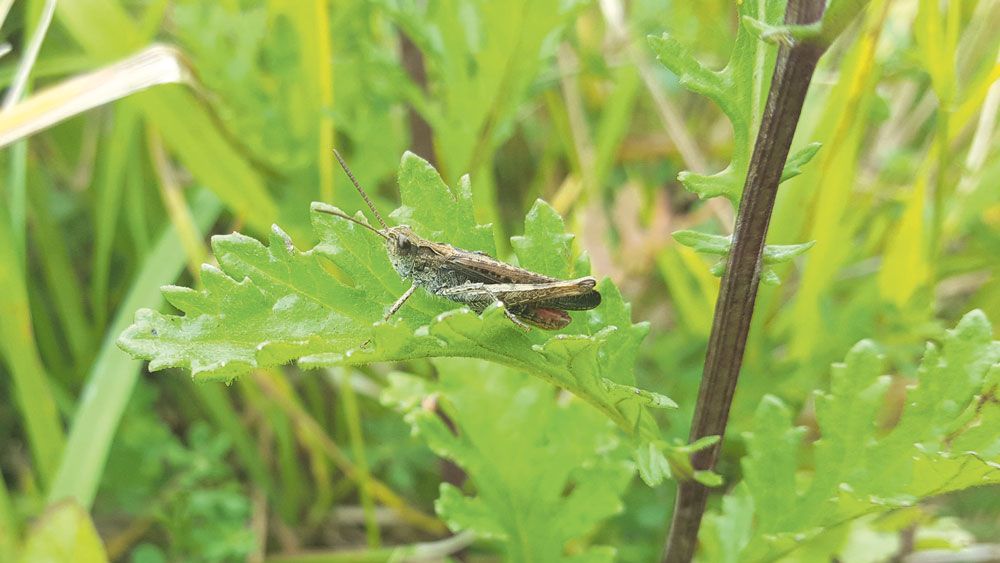
The brown Common Field Grasshopper males have orange tips on their abdomen
Nature on our doorsteps: Grasshoppers
Rosaleen Dwyer is the County Heritage Officer at South Dublin County Council – every week she gives us an insight into the natural heritage around us and the beautiful biodiversity of the plants and creatures.
THE CHIRPING sound of a grasshopper is a characteristic sound of summertime meadows.
Being mostly green or brown in colour, these insects are not easy to see, particularly in long grass. When disturbed, they use their powerful hind legs to catapult themselves out of danger, and they can jump up to 20 times their own body length.
As well as being able to jump really well, grasshoppers can also fly over short distances.
They have two sets of wings. A toughened pair of fore-wings protect a pair of delicate hind-wings that lie hidden away underneath the hardened wings until they are needed.
The grasshopper’s characteristic chirping ‘song’ is not a vocal sound that comes from their throats. Instead, a series of hardened growths, or pegs, are located along the inside edge of the grasshopper’s hind legs, and when the insect rubs its legs against the edge of its hardened wings, the pegs create the chirping sound.
Scientific studies show that grasshopper songs are very complex, with variations in timing, volume, and speed. Different grasshopper species have different patterns of chirping calls, and this can help us identify which species is present in the long grass.
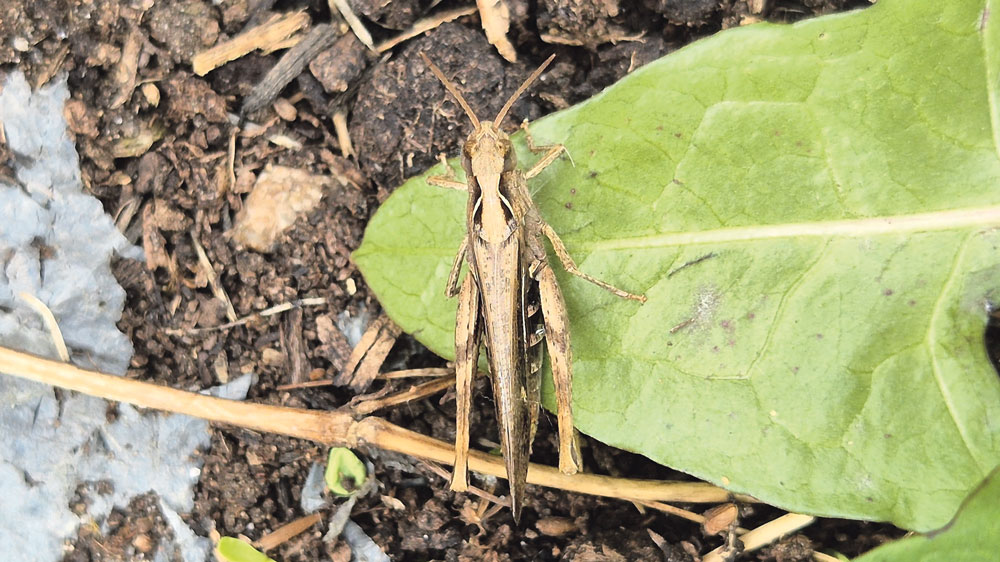
The Common Field Grasshopper is a large, mostly brown, insect
While a grasshopper male uses its calls to attract a mate and to challenge rival males, females will also chirp. They respond to a male’s song with a similar call pattern to indicate their presence.
While grasshoppers have biting mouthparts, they are herbivores, meaning they generally only feed on grass and leaves.
Ireland has seven species of grasshopper.
Two species are most often encountered in parks, meadows, and gardens, and these are the Common Green Grasshopper and the Common Field Grasshopper.
The Common Field grasshopper is a relatively large insect, and can measure up to 2.5cm, They are generally brown in colour and males have an orange tinge at the tip of their long abdomen.
The Common Green Grasshopper is a mostly green insect. It is generally slightly smaller than the Field Grasshopper, and it has no orange colouring.

