
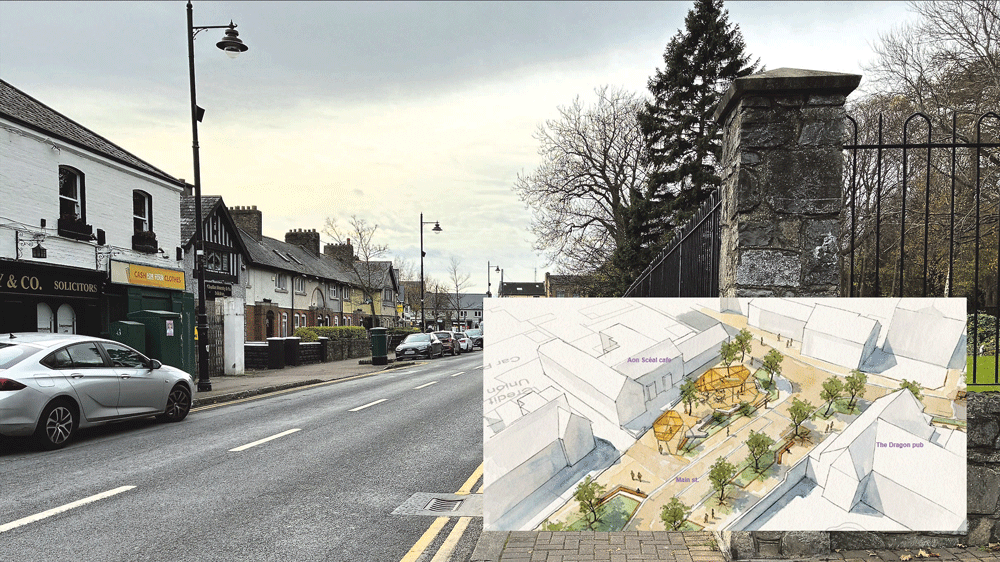
Tallaght village and (inset) and artist’s impression of the Village Enhancement Scheme
Business owners are concerned about potential trading impact
More than 60 submissions are available to view on the closed consultation portal for the Tallaght Village Enhancement Scheme, with an overall feeling that it be reconsidered.
Up to 66 submissions can be viewed by accessing the Part 8 Public Consultation for Tallaght’s planned Village Enhancement Scheme, with many expressing concerns about or their objection to the current iteration of the plans.
The ambition of the scheme and investment into the local area was often welcomed through the submissions, but issues were made clear with parking provisions, pedestrian crossings and the effect of the changes on businesses, among others.
None of these submissions were made available to view at the time the consultation was active. 141 were submitted to the council in total.
Business owners operating on the Main Street noted their concerns about the removal of parking spaces near their locations and the potential impact on passing trade.
One submission stated: “The current consultation proposals are imbalanced as regards the need to protect existing businesses and to encourage new businesses.
“Existing parking, vehicular access, bus access, and the pedestrian environment should be protected against proposals which would have knock-on consequences for local businesses and for local people.
“The proposals are currently contrary to the South Dublin County Development Plan 2022-2028 and would cause an adverse business environment at Main Street.”
“Finally, in other locations where such measures have been implemented, they tend to move towards more draconian approaches to traffic management and even full pedestrianisation.
“Our client wishes to confirm that the business cannot survive the current proposals let alone any further escalation which may arise should they proceed as set out.”
Residents who made submissions largely opposed the removal of parking spaces near their homes and the change in ease of access that would bring for homes with road frontage.
Many submissions called for more engagement with those who will be affected by the proposed changes, with a chunk of the submissions making clear their welcome attitude to such an investment to the village, but that more discussion is needed.
A submission called for an impact assessment to be carried out to see how the plans will affect businesses, and for the council to reconsider the extent to which on-street parking is planned to be removed.
The author noted that Tallaght Village is an Architectural Conservation Area and that public realm works within it must be sensitive to the “traditional functioning” of the village.
It stated: “The removal of [parking] infrastructure risks fundamentally altering the established pattern of use, which forms part of the ACA’s special character . . .
“. . . A village that is less accessible and less economically active is ultimately diminished, regardless of improvements in surface finishes or landscaping.”
She called on the council to adopt a “measured approach” – one that would the retention of some spaces, while also bring about the public realm enhancements proposed.
Another submission called for audio queues to be included in pedestrian crossings and noted an inconsistency in the delivery of these in South Dublin.
It stated: “There has been a marked inconsistency in the adequacy of signal crossings in South Dublin in terms of audio locator beacons and audio crossing beacons.
“It is important that a systematic improvement be made on those, not least in the area of Tallaght village concerning this Part 8.”
Other submissions pointed to other incoming public transport works in the nearby area and noted a lack of alignment with them – such as BusConnects.
One submission noted that the village will become “a gorgeous place” for people to enjoy the sun in the future with the public realm changes and called for lighting and CCTV to help this aspect flourish.
Looking at the submissions made publicly available, it is clear that concerns remain across several groups that will be affected by these changes, from residents and businesses to national authorities, who wish for revisions before plans move forward.
Funded by the Local Democracy Reporting Scheme.

